
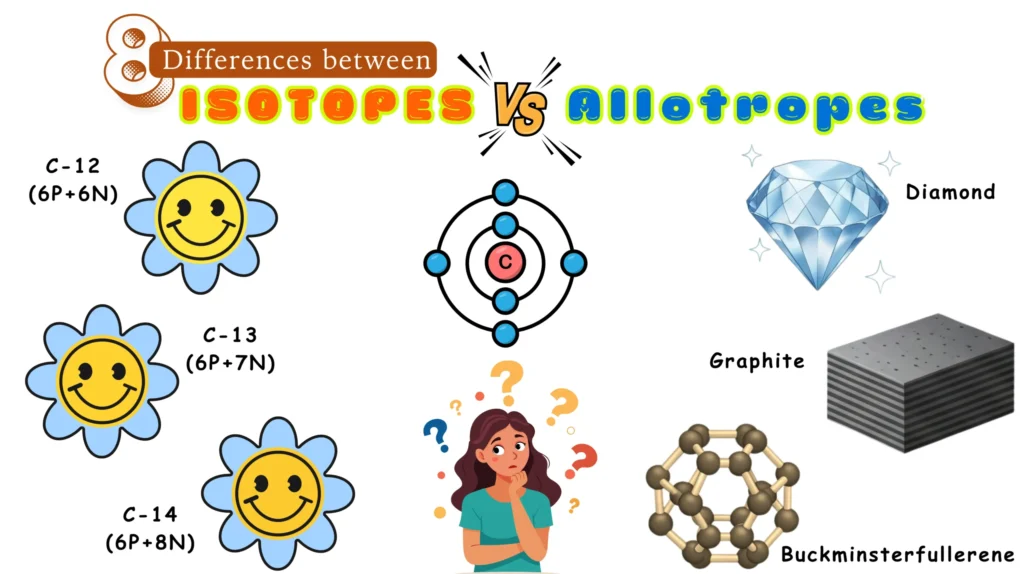
Discover the 8 key differences between isotopes and allotropes, and explore the fascinating variations of the same element in nature.
Table of Contents
Introduction
Isotopes and allotropes represent two fascinating ways in which the same element can exist in different forms. While isotopes differ in the number of neutrons in their atoms, allotropes differ in the structural arrangement of the same atoms. Both concepts reveal the versatility of elements in nature.
8 Differences between Isotopes vs Allotropes
The key differences between isotopes and allotropes are listed here.
| Feature | Isotopes | Allotropes |
| Definition | Atoms of the same element with the same number of protons but different numbers of neutrons. | Different structural forms of the same element in the same physical state. |
| Cause of Difference | Variation in the neutron number in the nucleus. | Variation in atomic arrangement or bonding. |
| Effect on Atomic Mass | Different isotopes have different atomic masses. | Allotropes have the same atomic mass. |
| Effect on Chemical Properties | Chemical properties remain mostly identical. | Chemical properties may differ significantly. |
| Effect on Physical Properties | Physical properties (density, boiling point, and melting point) may vary slightly. | Physical properties vary greatly (hardness, conductivity, and colour). |
| Examples | Carbon-12, Carbon-13, Carbon-14. | Diamond, Graphite, Graphene. |
| Field of Study | Nuclear chemistry and physics. | Solid-state chemistry and crystallography. |
| Applications | Medical imaging, radiocarbon dating, nuclear energy. | Industrial materials, lubricants, conductors, jewellery. |
What are Allotropes?
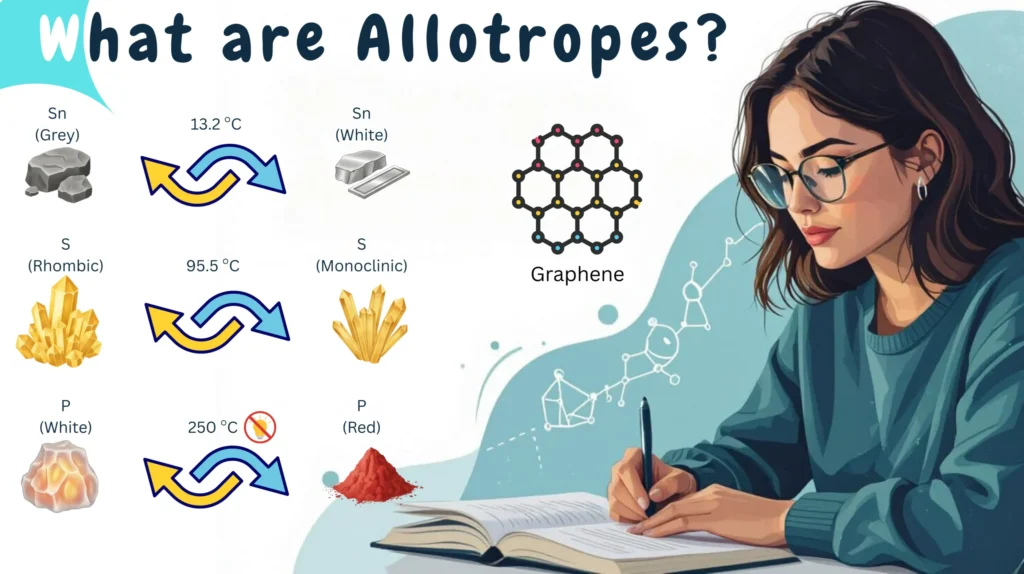
Allotropes are different structural forms of the same element. They are caused by variations in how atoms are bonded or arranged. The existence of such forms of a matter is called allotropy.
Characteristic Features of Allotropes
- Same type of atoms, different structural forms.
- Varying physical and sometimes chemical properties.
- Stable under specific conditions of temperature and pressure.
Causes of Allotropy
1. Different Number of Atoms per Molecule – Example: O₂ vs O₃.
2. Different Atomic or Molecular Arrangements in a Crystal – Example: Diamond vs graphite in carbon.
A Look into the Allotropes of Carbon
| Allotrope | Structure | Key Properties |
| Diamond | 3D tetrahedral network | Hardest natural substance, non-conductive, transparent. |
| Graphite | Layers of hexagonal carbon atoms | Good electrical conductor, soft, opaque. |
| Graphene | Single layer of carbon atoms in a hexagonal lattice | Exceptional strength, excellent conductor. |
| Buckminsterfullerene (C₆₀) | Spherical “buckyball” | High resilience, potential in nanotechnology. |
Transition Temperature
The transition temperature is the specific temperature at which two allotropes coexist in equilibrium. At this point, one form starts converting into another.
Key Point: Transition temperature is always below the melting point of the substance.
Examples of Transition Temperatures
| Substance | Allotrope 1 | Allotrope 2 | Transition Temp (°C) |
| Potassium Nitrate (KNO₃) | Orthorhombic | Rhombohedral | 128 |
| Sodium Sulphate | Hydrated (Na₂SO₄·10H₂O) | Anhydrous (Na₂SO₄) | 32.38 |
| Sodium Carbonate | Higher hydrated form (Na₂CO₃·10H₂O) | Lower hydrated form (Na₂CO₃·7H₂O) | 32.38 |
A Comparison of Key Examples of Allotropes
| Feature | Sulphur | Phosphorus | Tin |
| Allotrope Forms | Rhombic ↔ Monoclinic | White ↔ Red | Grey ↔ White |
| Equilibrium / Transition Equation | Rhombic ⇌ Monoclinic | White ⇌ Red | Grey ⇌ White |
| Transition Temperature (°C) | 95.5 | ~250 (in the absence of light) | 13.2 |
| Molecular / Structural Features | Both forms have S₈ rings; they differ in crystal packing | White: discrete P₄ molecules; Red: polymeric network | Grey: non-metallic structure; White: metallic bonding |
| Stability | Rhombic stable at RT; monoclinic stable above 95.5°C | Red stable at room temperature (RT); white is highly reactive | Grey stable below 13.2°C; white stable above |
| Appearance | Rhombic: yellow crystals; Monoclinic: needle-like | White: waxy, translucent; Red: amorphous powder | White: silvery metallic; Grey: dull and brittle |
| Reactivity | Low reactivity under normal conditions | White is very reactive and poisonous; red is relatively inert | White conducts electricity; grey is a poor conductor |
| Notable Differences | Mainly in crystal structure and density; minor changes in hardness and colour | Large differences in reactivity, safety, and stability | Major changes in conductivity, strength, and appearance; “tin pest” in cold |
What Are Isotopes?
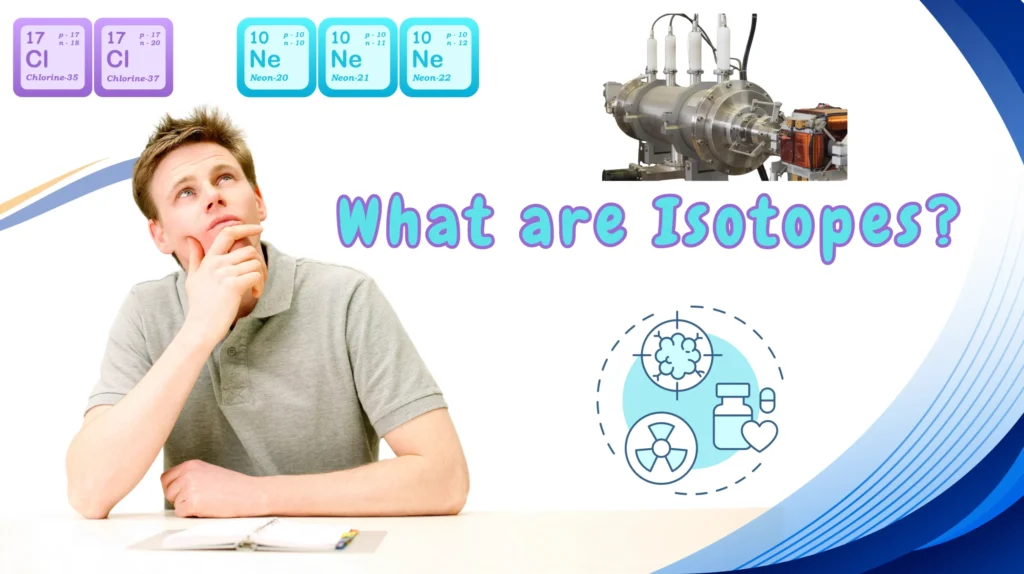
Isotopes are forms of the same element that have the same number of protons but different numbers of neutrons, giving them different mass numbers. This phenomenon is called isotopy.
Historical Background
Isotopes were discovered in the early 20th century by Frederick Soddy. Its discovery challenged Dalton’s belief that all atoms of an element have identical mass.
Characteristic Features of Isotopes
- Different mass numbers.
- Identical atomic number (same element).
- Different nuclear properties and stability.
- Nearly identical chemical behaviour due to the same electron configuration.
Causes of Isotopy
Isotopy arises because the nucleus can accommodate different numbers of neutrons while maintaining the same proton count. For example, hydrogen has:
- Protium (¹H) – 1 proton, no neutrons.
- Deuterium (²H) – 1 proton, 1 neutron.
- Tritium (³H) – 1 proton, 2 neutrons (radioactive).
This neutron variation changes mass and nuclear stability without altering the fundamental identity as hydrogen.
A Look into the Isotopes of Carbon
| Isotope | Neutrons | Stability | Uses |
| Carbon-12 (¹²C) | 6 | Stable | Standard atomic mass reference. |
| Carbon-13 (¹³C) | 7 | Stable | NMR spectroscopy, metabolic studies. |
| Carbon-14 (¹⁴C) | 8 | Radioactive | Radiocarbon dating (half-life ~5730 years). |
A Comparison of Key Examples of Isotopes
| Feature | Chlorine | Oxygen | Uranium |
| Isotopes | ³⁵Cl, ³⁷Cl | ¹⁶O, ¹⁷O, ¹⁸O | ²³⁴U, ²³⁵U, ²³⁸U |
| Neutrons | 18, 20 | 8, 9, 10 | 142, 143, 146 |
| Stability | Stable | Stable | ²³⁴U, ²³⁵U (fissile), ²³⁸U (fertile) |
| Key Uses | Disinfectants, PVC production | Isotope tracing in climate and metabolic studies | Nuclear fuel, power generation, weaponry |
Note
- Elements with even atomic numbers often have several stable isotopes.
- Elements with odd atomic numbers rarely have more than two stable isotopes.
- Isotopes whose mass numbers are multiples of four (like ¹⁶O, ²⁴Mg, ⁴⁰Ca) are especially abundant.
- Elements like nickel, calcium, palladium, cadmium, and tin each have multiple stable isotopes.
- Some elements like fluorine, iodine, and gold have only one stable isotope, making them mono-isotopic elements.
Relative Abundance of Isotopes
Relative abundance of isotopes refers to the percentage (or fraction) of each isotope of an element found in a naturally occurring sample of that element. It is usually expressed as a percentage by number of atoms, not by mass.
Example
| Element | Isotope | Relative Abundance (%) |
| Chlorine (Cl) | ³⁵Cl, ³⁷Cl | 75.77%, 24.23% |
| Oxygen (O) | ¹⁶O, ¹⁷O, ¹⁸O | 99.757%, 0.038%, 0.205% |
| Uranium (U) | ²³⁴U, ²³⁵U, ²³⁸U | 0.0055%, 0.720%, 99.274% |
| Neon (Ne) | ²⁰Ne, ²¹Ne, ²²Ne | 90.48%, 0.27%, 9.25% |
| Bromine (Br) | ⁷⁹Br, ⁸¹Br | 50.69%, 49.31% |
This ratio is used to calculate the average atomic mass of an element on the periodic table.
Note
At present, scientists know of:
- ~280 naturally occurring isotopic forms
- ~40 naturally radioactive isotopic forms
- ~300 artificially produced radioactive isotopic forms
Radioactive Isotopes
When the ratio of protons to neutrons in an atomic nucleus is unstable, the nucleus can lose energy by emitting radiation. This process is called radioactive decay, and isotope that undergoes it is known as radioisotope or radioactive isotope.
During radioactive decay, the nucleus transforms into a different isotope or even a different element, releasing energy in the form of alpha particles (α), beta particles (β), or gamma rays (γ).
Examples of Decay Steps
²³⁸U → ²³⁴Th + α + energy
²³⁴Th → ²³¹Pa + β⁻ + energy
²¹⁰Bi → ²⁰⁶Tl + β⁻ + energy
Some decay sequences (decay chains) end with a stable isotope that no longer emits radiation, while others pass through multiple unstable isotopes before reaching stability.
Applications of Isotopes
| Field | Application |
|---|---|
| Medicine | Radiotherapy: P-32, Sr-90 (skin cancer), Co-60 (deep cancers) Diagnostics: Tc-99m (organ scans), I-131 (thyroid tests) |
| Archaeology & Geology | Radiocarbon dating (¹⁴C) Potassium-argon dating (K-40) |
| Science & Industry | Tracing reactions with isotope labelling (C-14) Material flaw detection Nuclear energy (U-235) |
Mass Spectrometer
A mass spectrometer measures the exact masses and abundances of isotopic forms of an element. This allows scientists to:
- Calculate relative atomic masses
- Determine isotope ratios in samples
- Identify trace isotopes in environmental and archaeological studies
Conclusion
The comparison of isotope and allotrope tells many different stories depending on how you look at it.
Allotropy beautifully demonstrates arrangement, bonding, and molecular size. It dramatically changes the properties of a single element. From the hardness of diamond to the slipperiness of graphite, and from the toxicity of white phosphorus to the stability of red phosphorus, allotropes are practical.
Isotopic forms are identical twins that may appear in the same position of the periodic table, but their subtle differences unlock a vast range of scientific possibilities. They serve their function from life-saving medicine to unlocking the history of our planet.
Frequently Asked Questions (FAQs)
Why have isotopes not been shown in the periodic table? Which particle is present in a different number in the isotope?
The periodic table is based on atomic number (the number of protons), which is the same for all isotopic forms of an element.
Isotopic forms differ in the number of neutrons, not protons, which is why they are not separately shown in the table.
In which isotope of oxygen are the numbers of protons, electrons, and neutrons equal?
In Oxygen-16 (¹⁶O), the numbers of protons, neutrons, and electrons are all 8.
Rubidium consists of two isotopes, ⁸⁵Rb and ⁸⁷Rb. The percent abundance of the lighter isotope is 72.2%. What is the percent abundance of the heavier isotope? Its atomic mass is 85.47.
Since the total abundance is always 100%, the heavier isotope ⁸⁷Rb must have an abundance of 27.8%.
How is radiocarbon dating useful for archaeologists?
Radiocarbon dating uses the radioactive isotope carbon-14 (¹⁴C) to estimate the age of once-living materials (wood, bones, fossils). Archaeologists use it to date ancient artefacts and remains up to about 50,000 years old, helping reconstruct human history.
Why are elements different from one another?
Elements differ because they have different numbers of protons in their nuclei. This difference changes their atomic number, electron configuration, and thus their unique chemical properties.
Why is tritium a radioactive element?
Tritium (³H) has 1 proton and 2 neutrons. The nucleus is unstable because the neutron-to-proton ratio is too high, causing it to undergo radioactive decay (beta decay) into helium-3.
What is radioactivity? Why are the nuclei of radioactive elements unstable? Explain any three applications of radioactive isotopes.
Radioactivity is the spontaneous emission of particles or energy from an unstable nucleus. Nuclei become unstable when the balance between protons and neutrons is not favourable.
Applications of radioactive isotopes:
- Archaeology – Radiocarbon dating with ¹⁴C.
- Medicine – Co-60 in radiotherapy, I-131 in thyroid treatments.
- Industry – Detecting leaks, checking weld quality, and tracing chemical processes.
Both graphite and graphene have hexagonal layered structures. What is the difference?
- Graphite consists of many stacked layers of hexagonal carbon sheets held by weak van der Waals forces.
- Graphene is a single layer of hexagonal carbon atoms. It is stronger, lighter, and conducts electricity better than graphite.
What are allotropic forms? Explain the allotropic forms of carbon (C) and sulphur (S). How does coal differ from diamond?
Allotropic forms are different structural arrangements of the same element in the same physical state.
- Carbon allotropic forms: Diamond (hard, transparent, non-conductor), Graphite (soft, conductor), Graphene (strong, 2D sheet), Fullerenes (spherical cages).
- Sulphur allotropic forms: Rhombic sulphur (stable at room temperature) and Monoclinic sulphur (stable above 95.5°C).
- Coal vs Diamond: Coal is an amorphous (non-crystalline) form of carbon, while diamond is a crystalline allotrope with a rigid tetrahedral network.
Why is graphene called a “miracle material” and considered the material of the future?
Graphene is only one atom thick, yet it is 200 times stronger than steel, a superb conductor of electricity and heat, flexible, and nearly transparent. These properties make it ideal for next-generation electronics, flexible displays, super-capacitors, and nanotechnology applications.