
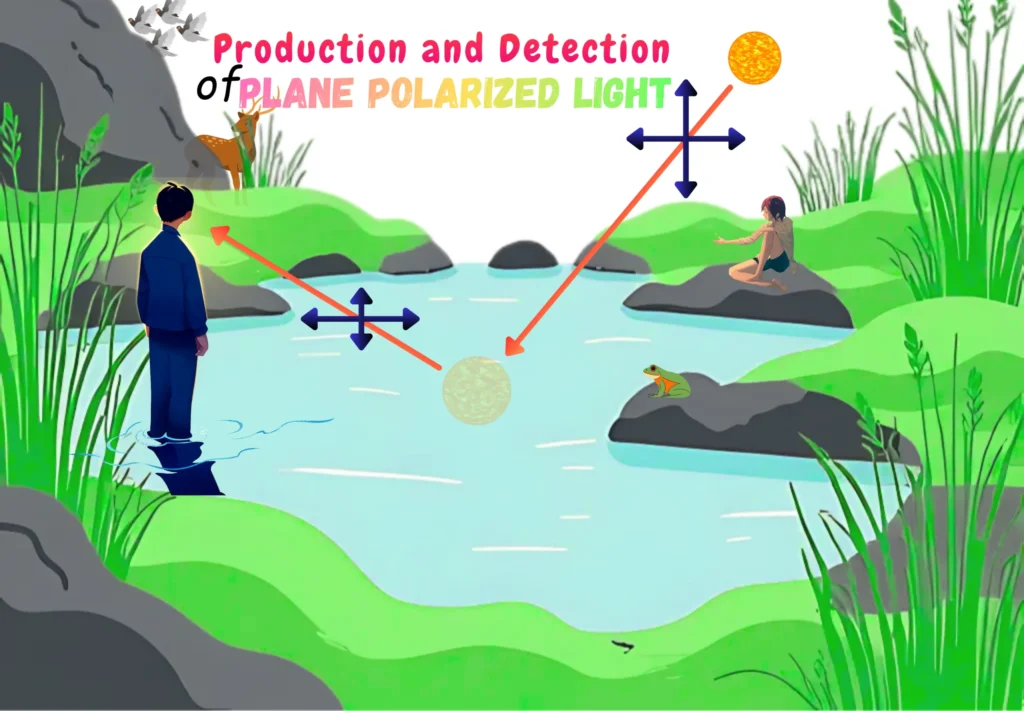
Understanding of the production and detection of plane polarized light is the first step to dive deeper into the world of polarization.
Table of Contents
Introduction
Polarization is a fundamental property of light that describes the orientation of its electric field vibrations. The basics of this idea have already been discussed; click here. To dive deeper into the ideas of polarization, you first need to explore production, detection, and the effects of polarized light.
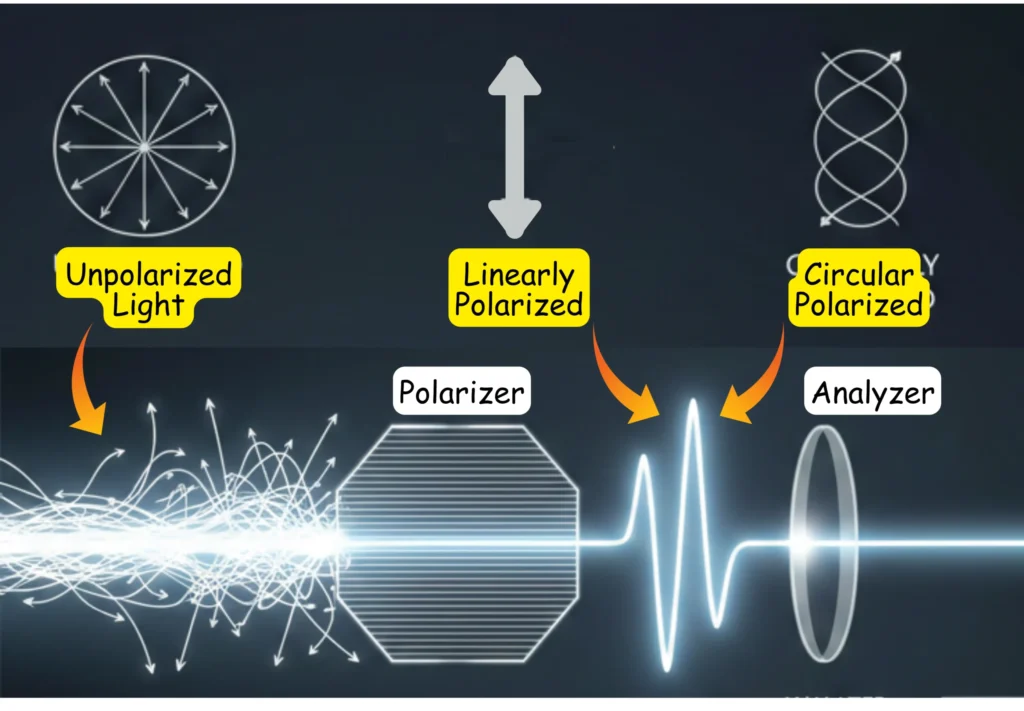
Let us start our discussion with simple concepts.
Difference between Unpolarized Light and Polarized Light
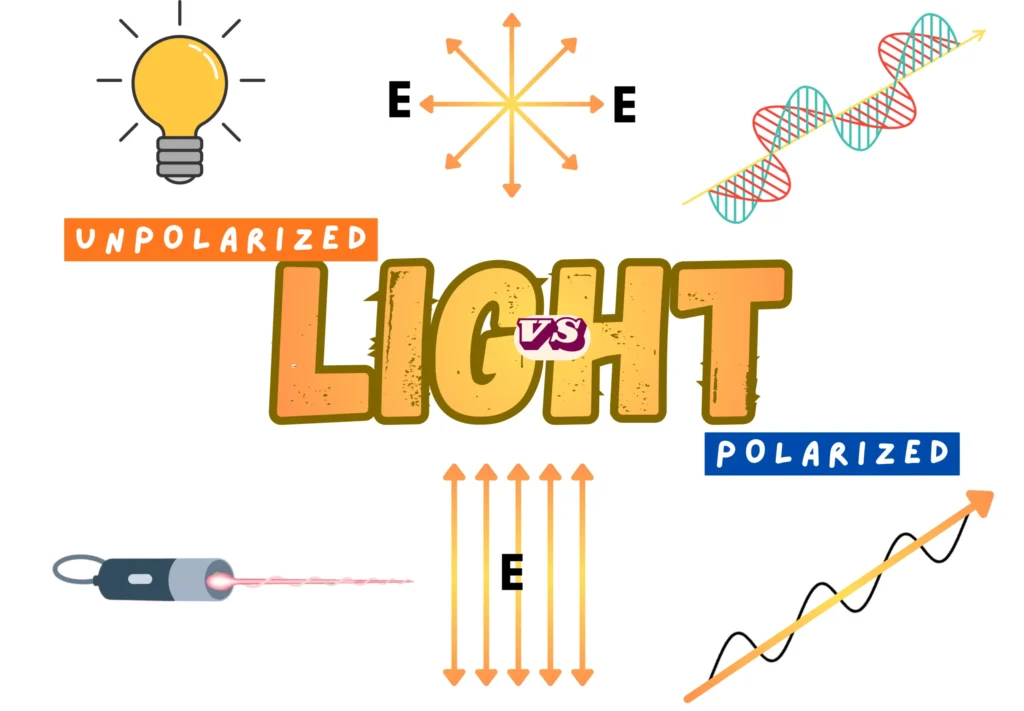
Here is a quick recall of the differences between unpolarized light and polarized light.
Unpolarized Light
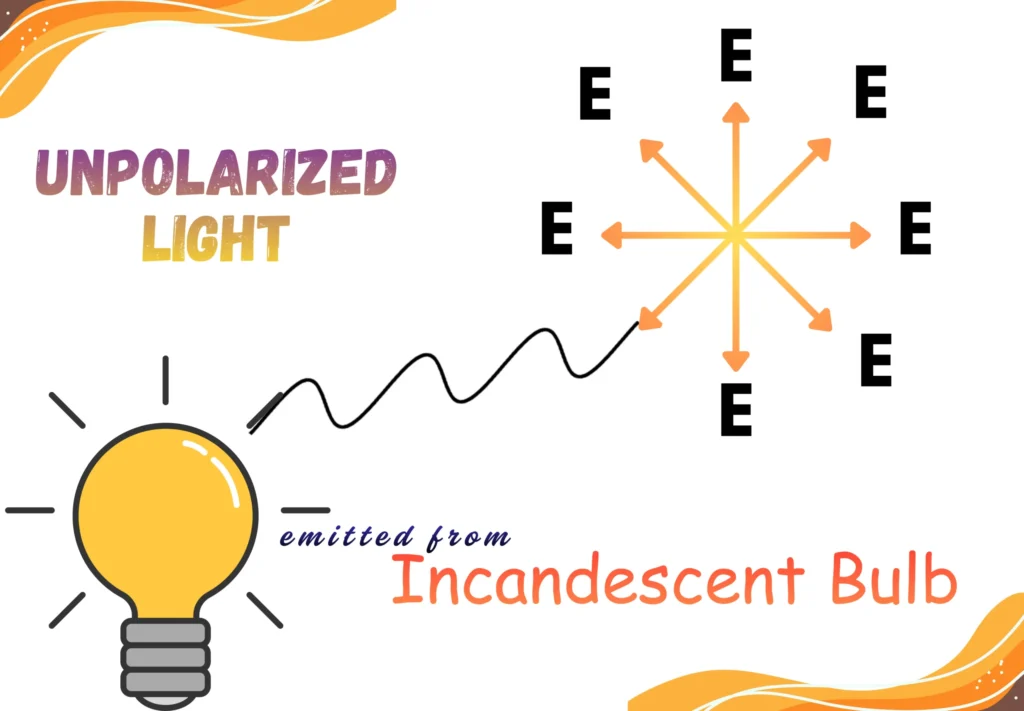
Ordinary light sources emit vibrations in all possible planes, making the light unpolarized.
Examples
- Firelight
- Sunlight
- Candlelight
- Incandescent or fluorescent bulbs
Polarized Light
If the vibrations of the electric field are confined to one plane, the light becomes polarized.
Example
- Laser light
- LCDs
- Light passing through birefringent crystals
| Feature | Unpolarized Light | Polarized Light |
| Vibration Direction | Multiple random planes | Single plane |
| Examples | Sunlight, bulbs | Polarized sunglasses, LCD light |
| Production | Natural sources | Filters, reflection, scattering |
| Glare Reduction | No | Yes |
| Uses in Tech | General illumination | Photography, displays, optics |
| Transmission Through Polarizer | 50% | Depends on angle (Malus’ Law) |
Production and Detection of Plane Polarized Light
Light emitted from an ordinary incandescent bulb is unpolarized, meaning its electric field vibrations are randomly oriented in space.
Polarization Using Polaroids
When unpolarized light passes through a Polaroid sheet (polarizer), the transmitted light becomes plane polarized.
Adding a second Polaroid sheet (analyzer) allows control over transmitted light intensity.
Rotation of Analyzer w.r.t Polarizer
If the transmission axes of the polarizer and analyzer are parallel, light passes through both sheets.
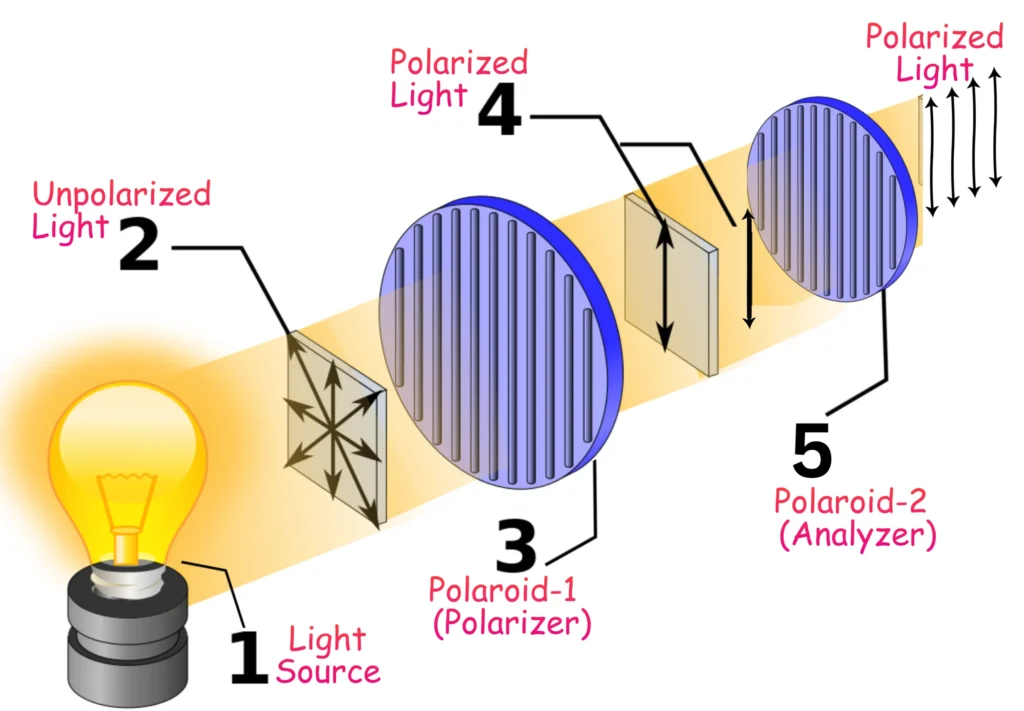
If the analyzer is slowly rotated w.r.t the polarizer, the following may happen:
- The transmitted intensity decreases.
- It reaches zero when the axes are perpendicular.
- Further rotation restores the light as axes realign.
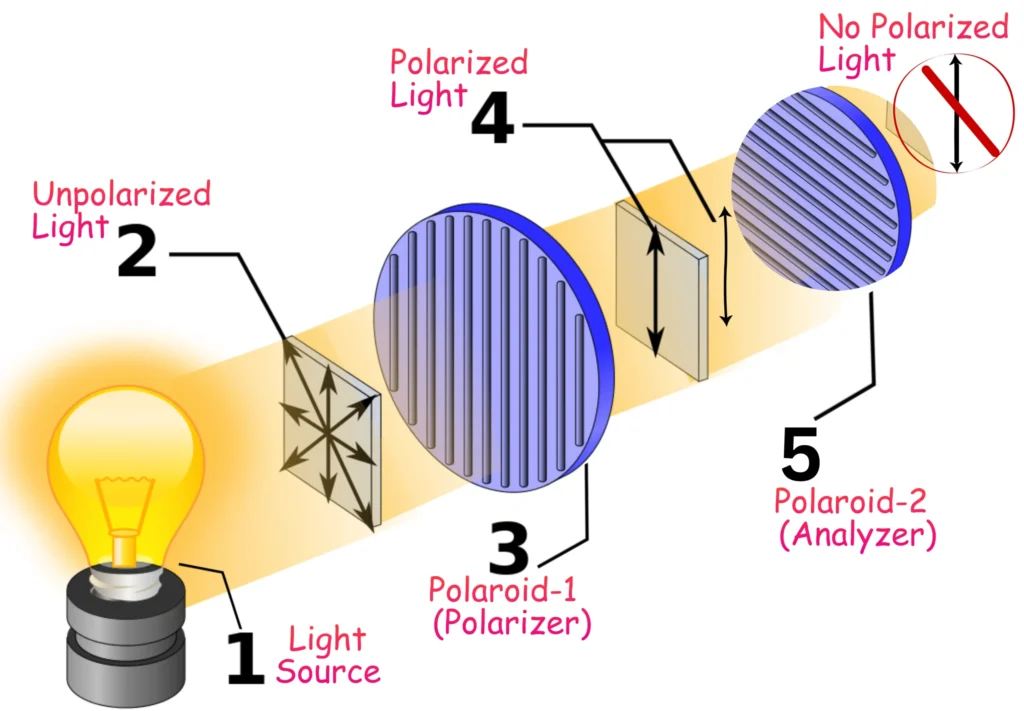
Key Insight
This activity validates that light is a transverse wave. If it were longitudinal, the intensity would never fall to zero, even with crossed Polaroids.
Polarization of Light by the Method of Reflection
Malus’s Discovery
In 1808, Malus discovered that ordinary light becomes polarized when reflected from a plane glass surface.
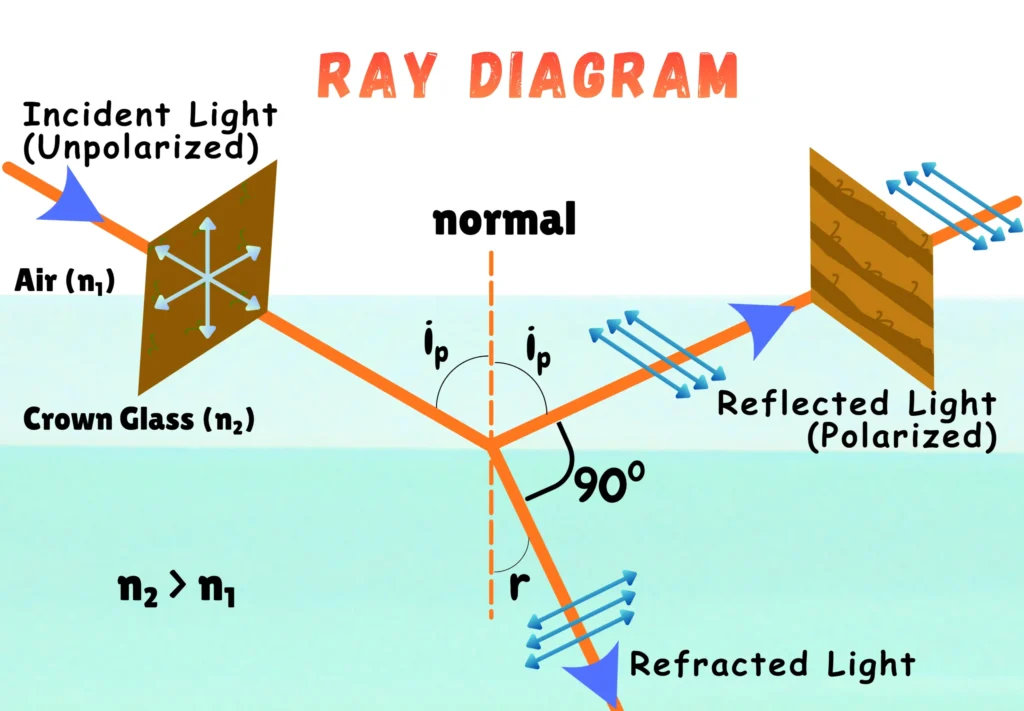
- Observing the reflected light through a rotating Polaroid shows that light almost disappears at a specific orientation.
- On glass, this occurs at an angle of incidence ≈ of 57°.
Surfaces like tables also partially polarize reflected light, as seen by their dimming under a rotating Polaroid.
Brewster’s Law
Brewster’s Law states that:
“The angle of incidence at which reflected light is completely plane polarized is such that the reflected and refracted rays make a right angle with each other”.
Brewster Angle
The polarizing angle, or Brewster angle, is the angle of incidence where reflected light is completely plane polarized.
Relation between Angles
Let!


By geometry:

Snell’s Law
From Snell Law:



The mathematical form of Brewster’s Law is:

For air  , so, it can also be written as:

The tangent of the Brewster angle equals the refractive index of the reflecting medium.
Optical Activity
Optical activity is the ability of certain substances to rotate the plane of polarization of light passing through them.
Examples of Optically Active Substances
- Cinnabar (HgS)
- Sugar solution
- Collagen
- Insulin
- Quartz
Factors Affecting Rotation
Optical activity is influenced by multiple factors, including:
- Path length of light through the substance
- Wavelength of light
- Type of substance
- Concentration
Cause
Optical activity arises from asymmetric (often helical) molecular structures.
Application
Measuring the rotation of polarized light through a sugar solution allows for determining its concentration.
Conclusion
Polarization is a powerful concept that reveals the vector nature of light. By using Polaroids, reflection at Brewster’s angle, or optically active substances, you can manipulate plane-polarized light.
These foundational ideas pave the way for advanced study in optics, imaging, communication, and material science.
Frequently Asked Questions (FAQs)
What is the key purpose of an analyzer in a polarization experiment?
The key purpose of an analyzer is:
“To detect and measure the presence and orientation of plane polarized light”.
It helps to determine:
- whether the light is polarized, and
- the direction of its plane of polarization.
If the analyzer is rotated, changes in transmitted intensity reveal the polarization state.
What is Brewster’s Angle?
Brewster’s angle is the angle of incidence at which light reflected from a surface becomes completely plane polarized.
At this angle:
- The reflected and refracted rays are perpendicular (90°) to each other.
- The reflected light is fully polarized in a direction perpendicular to the plane of incidence.
It is given by Brewster’s law:
Where


What are the applications of Brewster’s angle?
Brewster’s angle is used in:
- Photography
- Laser technology
- Anti-glare sunglasses
- Optical coatings & design
- Glare reduction in displays and screens
Would it be possible to use a polarizer as an analyzer? If yes, give at least two examples.
Yes!
A polarizer and analyzer are physically the same device. Their job depends on how you use them.
Examples
1. Checking the polarization of reflected light
A Polaroid acting as an analyzer will dim the reflected light at specific angles.
2. Determining the polarization direction of laser light
Rotating a second polarizer (used as analyzer) shows maximum or minimum intensity.
What do you know about the production and detection of plane polarized light?
Plane polarized light can be produced using:
- Scattering
- Reflection at Brewster’s angle
- Polaroid sheets (selective absorption)
- Birefringent crystals (double refraction)
It can be detected using:
- An analyzer, which changes intensity as it rotates
- Optical activity, where the plane of polarization rotates in a solution
- Polarization by reflection, where brightness changes under a Polaroid
What do you know about production and detection of plane polarized light?
OR
How can the plane polarized light be produced and detected? What does it prove?
Production
- Passing unpolarized light through a polarizer
- Using reflection at Brewster’s angle
- Passing through a birefringent crystal
Detection
- Observing intensity changes with a rotating analyzer
What it proves
These experiments prove that light is a transverse wave. It is because only transverse waves can have different vibration directions filtered or eliminated.
How can polarized light be obtained by the method of reflection? Explain.
Polarized light is obtained by reflection when light strikes a surface at a specific angle called the Brewster angle.
At this angle:
- The reflected and refracted rays are at 90° to each other.
- The reflected light becomes completely plane polarized perpendicular to the plane of incidence.
This is described by Brewster’s law:
Where
Common examples:
- Glare from water, glass, or shiny surfaces
- Polarization in photography and sunglasses
What is meant by optical activity? Discuss it.
Optical activity is the property of certain substances to rotate the plane of polarization of light passing through them.
Causes
- Asymmetry or chirality in molecules
- Helical or non-superimposable structures
Examples
- Cinnabar (HgS)
- Sugar solution
- Collagen
- Quartz
- Insulin
Factors affecting rotation
- Path length
- Wavelength
- Nature of substance
- Concentration
Applications
- Measuring concentration of sugar solutions (polarimetry)
- Studying biological molecules
- Pharmaceutical quality control