
Aberration of lenses and defects of vision are the result of imperfect refraction of light rays through a lens.
Table of Contents
Introduction
Lenses are important optical devices. They are used in cameras, microscopes, telescopes, spectacles, projectors, and many other instruments. A lens bends light and forms an image of an object.
Ideally, all light rays from an object should meet at exactly one designated point and form a clear image.
In practice, however, lenses are not perfect. Different light rays may focus at different points, or different colours of light may form images at different positions.
These problems are called aberrations of lenses and defects of vision.
Here, we will learn:
- What is aberration of a lens?
- What is spherical aberration?
- What is chromatic aberration?
- Causes and physics of spherical aberration
- Causes and physics of chromatic aberration
- How lens aberrations can be corrected
- What are defects of vision?
- What is short-sightedness or myopia?
- Causes and physics of myopia
- How myopia is corrected
- What is long-sightedness or hypermetropia?
- Causes and physics of hypermetropia
- How hypermetropia is corrected
1. Aberration of Lenses
Aberration of a lens is an optical error. It occurs when a lens fails to form a perfectly sharp image of an object.
Ideally, all rays coming from an object should meet at a single point after passing through the lens to produce a sharp image.
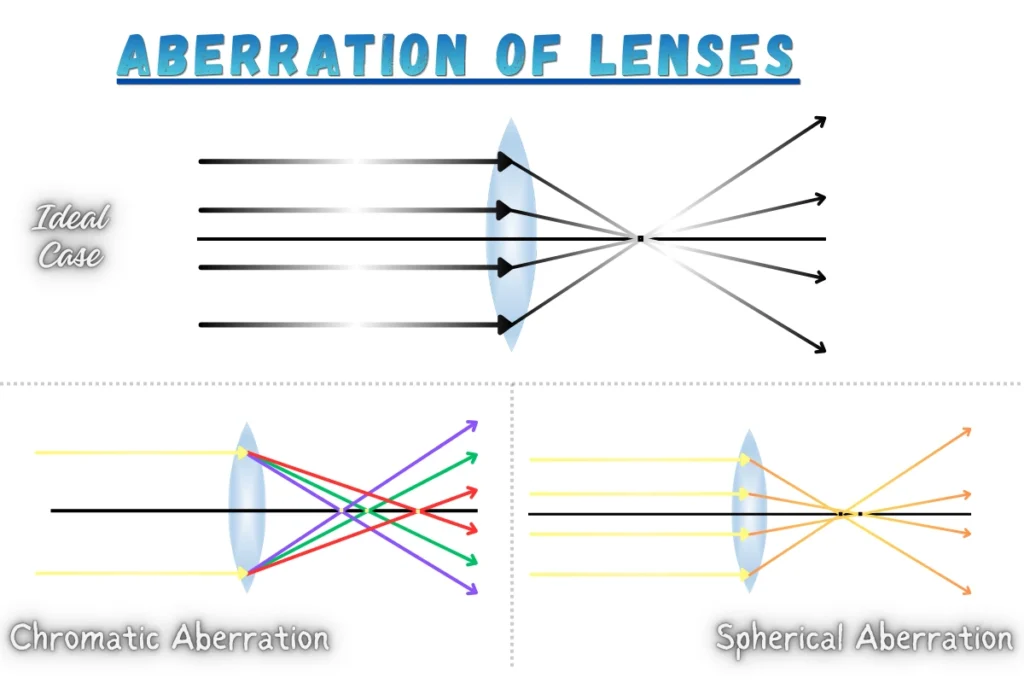
However, a real lens may bend the rays that meet at different points. As a result, the image may appear:
- Blurred
- Distorted
- Coloured around the edges
- Less sharp than expected
Lens aberrations occur because of the physical properties and shape of lenses.
Types of Optical Aberration
There are several types of optical aberrations. The 2 most important types are:
- Spherical aberration
- Chromatic aberration
What is Spherical Aberration?
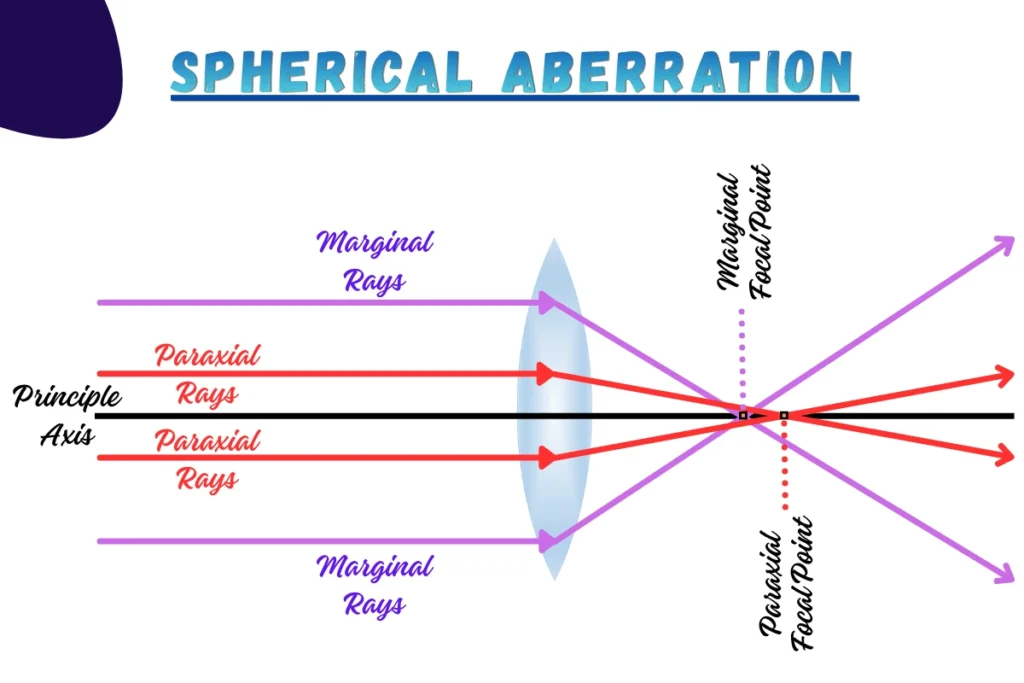
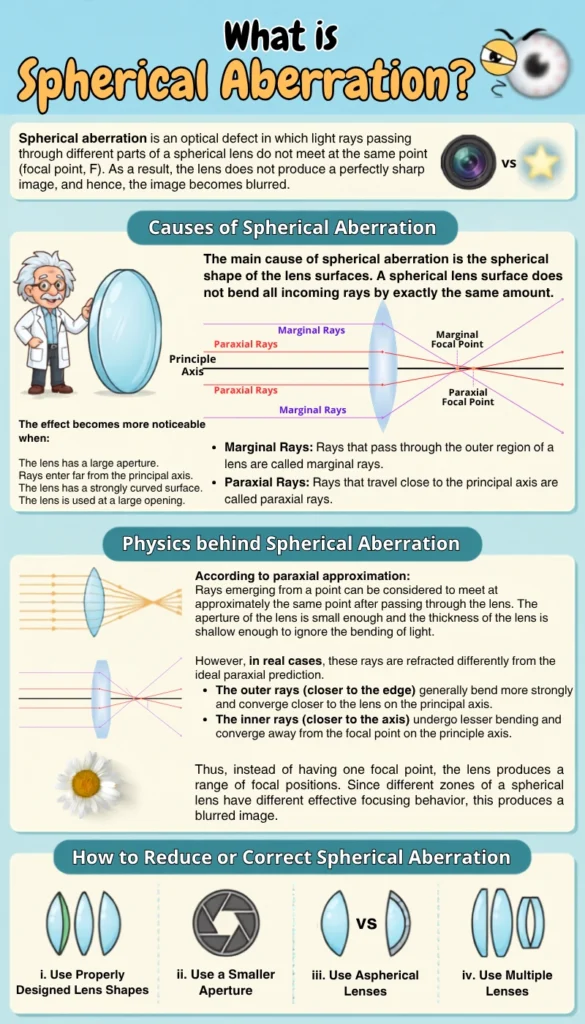
Spherical aberration is an optical defect in which light rays passing through different zones of a spherical lens do not meet at the same point after refraction.
As a result, the lens cannot form a perfectly sharp image.
Cause
The main cause of spherical aberration is the spherical shape of the lens surfaces.
Rays passing through the outer parts of the lens are refracted more strongly than rays passing close to the principal axis.
Effect on the Image
Because the rays do not converge at one point, the image becomes blurred or less sharp.
The amount of blur generally increases when rays farther from the principal axis are allowed to enter the lens.
Correction
Spherical aberration can be reduced or corrected by:
- Using aspherical lens surfaces.
- Using a smaller aperture to block outer rays.
- Combining suitable lenses to reduce the overall aberration.
What is Chromatic Aberration?
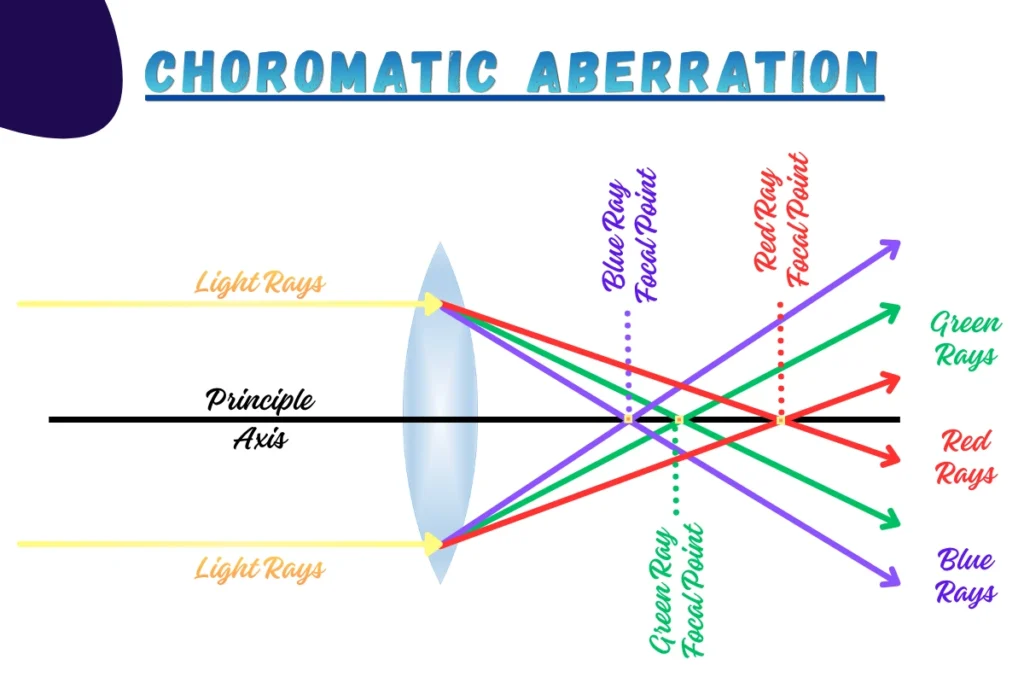
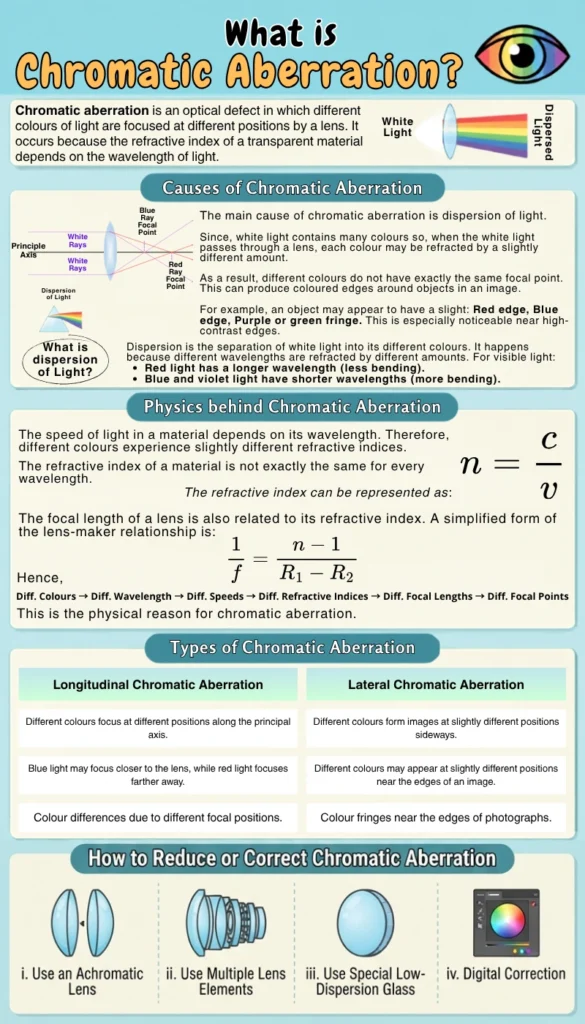
Chromatic aberration is an optical defect in which different colours of light do not focus at the same point after passing through a lens.
It occurs because different wavelengths of light are refracted by different amounts.
Cause
The main cause of chromatic aberration is dispersion of light.
When white light enters a lens, its different colours bend by different amounts because the refractive index of the lens varies with wavelength.
Types and Effect
Chromatic aberration may produce coloured fringes and colour blur around an image.
In longitudinal chromatic aberration, different colours focus at different positions along the principal axis.
In lateral chromatic aberration, different colours may form images at slightly different sideways positions.
Correction
Chromatic aberration can be reduced by using:
- Achromatic lenses.
- Special optical glass.
- Suitable combinations of lenses with different dispersive properties.
Spherical Aberration vs Chromatic Aberration
| Feature | Spherical Aberration | Chromatic Aberration |
| Main Cause | Shape of lens surfaces | Dispersion of light |
| Depends on | Position of ray across lens | Wavelength or colour |
| Rays involved | Different zones of the lens | Different colours |
| Main effect | Image blur | Coloured fringes and colour blur |
| Correction | Aperture, aspherical surfaces, lens combinations | Achromatic lenses, special glass, lens combinations |
Spherical aberration is mainly related to the position of a ray on the lens, while chromatic aberration is related to the colour or wavelength of light.
Defects of Vision
The human eye is a natural optical system. It uses a lens to focus light onto the retina.
For clear vision, light from an object should form a sharp image on the retina.
Sometimes the eye cannot focus light correctly on the retina. This condition is called a defect of vision or refractive error.
Kinds of Defects of Vision
Common defects of vision include:
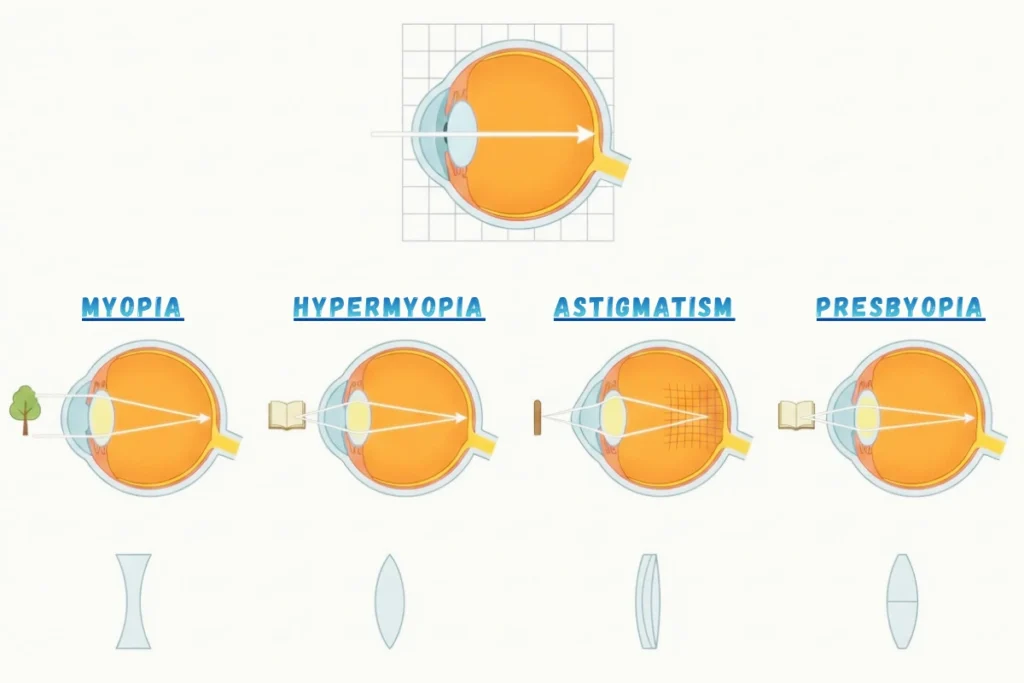
Here, we shall focus on just the 2 important defects:
- Short–Sightedness (Myopia)
- Long–Sightedness (Hypermetropia)
What is Short–Sightedness (Myopia)?
Myopia is a defect of vision in which a person can see nearby objects clearly, but distant objects appear blurred.
It is commonly called short-sightedness.
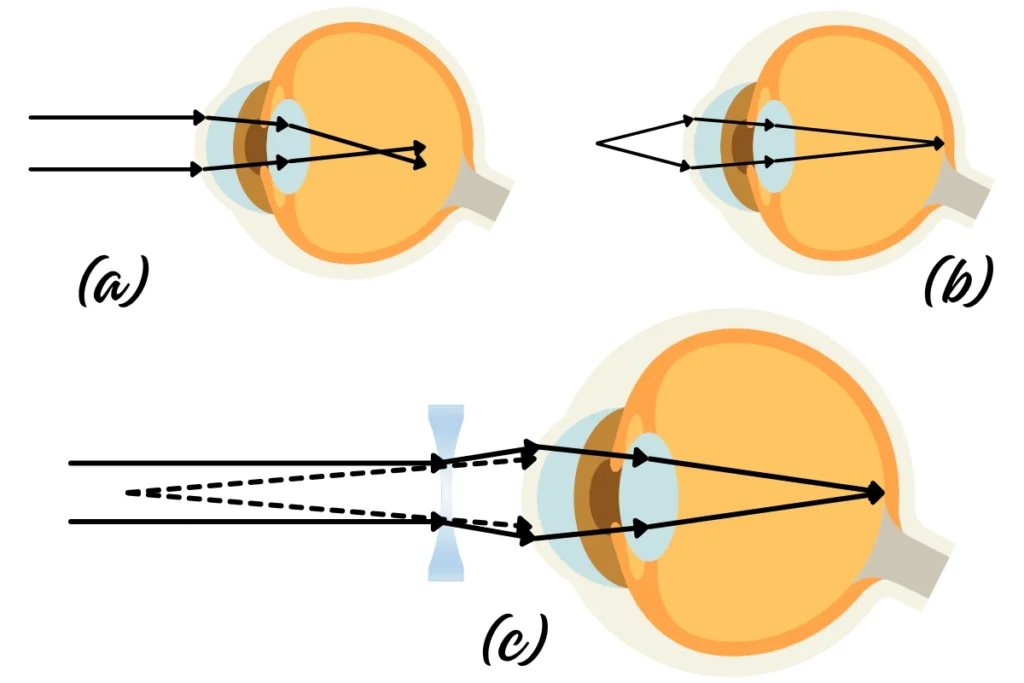
Clear Vision and Problem
A person with myopia can see nearby objects clearly because light from these objects can be focused properly. However, light from distant objects is focused incorrectly, so distant objects appear blurred.
Focus Without Correction
In myopia, the light rays from a distant object are focused in front of the retina instead of directly on the retina.
Common Physical Causes
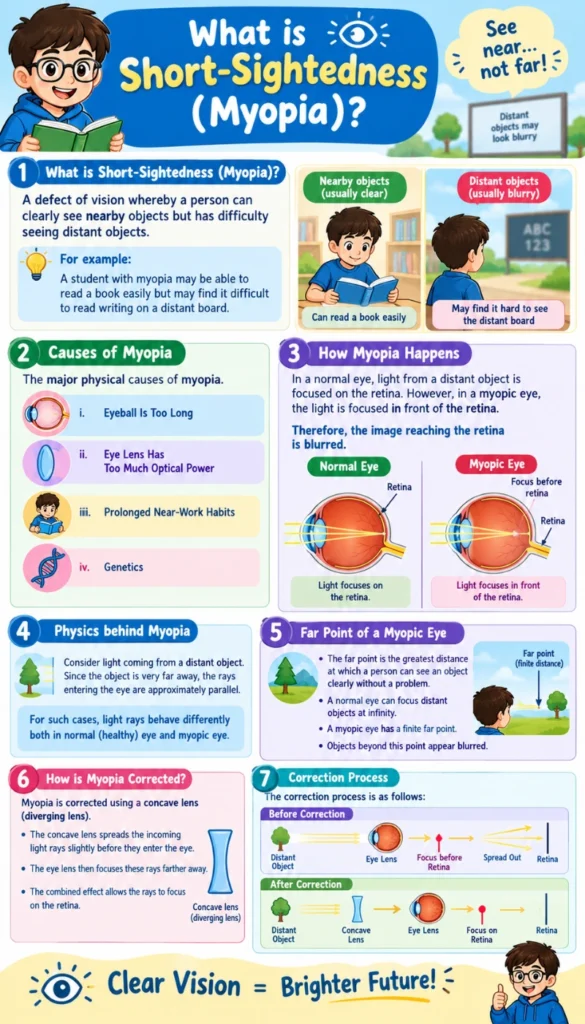
Myopia commonly occurs when:
- The eyeball is too long.
- The optical power of the eye is too strong.
Correcting Lens
Myopia is corrected using a concave lens.
A concave lens is a diverging lens. It spreads the incoming light rays slightly before they enter the eye, allowing the eye to focus the rays on the retina.
Power of a Correcting Lens for Myopia
A concave lens has a negative focal length, so its power is negative. Therefore, the corrective lens used for myopia usually has negative power.
The power of the lens is given by:

Where:
- P = power of the lens in dioptres (D)
- f = focal length in metres
For example:

It means the correcting lens has a power of minus two dioptres.
What is Long–Sightedness (Hyperopia)?
Hypermetropia is a defect of vision in which a person can see distant objects clearly, but nearby objects appear blurred.
It is commonly called long-sightedness or hypermetropia.
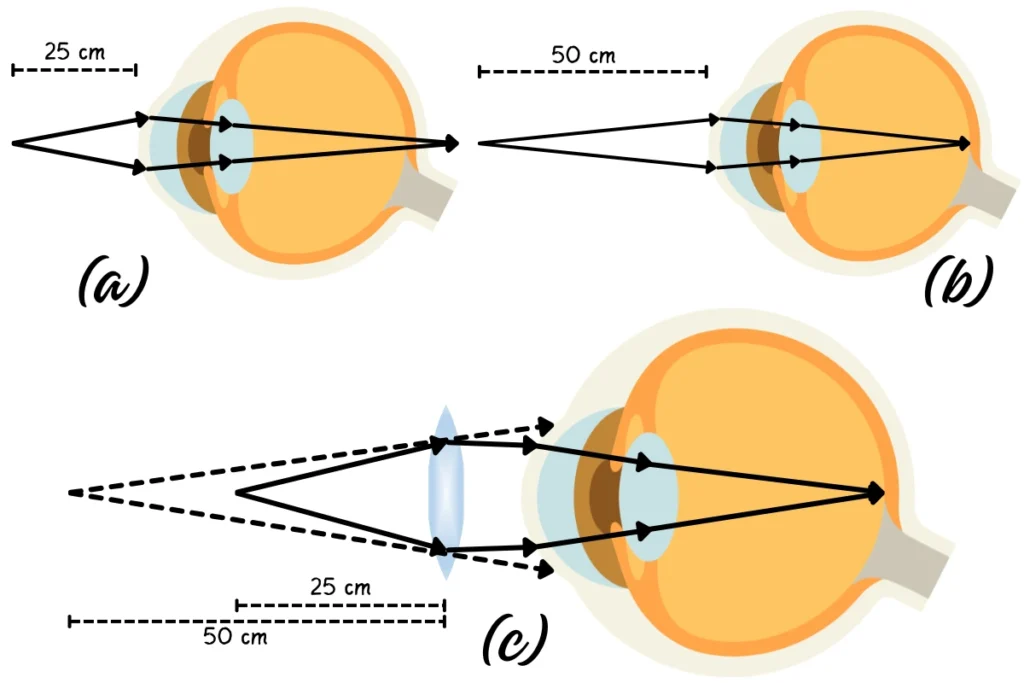
Clear Vision and Problem
A person with hypermetropia can see distant objects clearly, but has difficulty seeing nearby objects clearly. This makes tasks such as reading or viewing close objects difficult.
Focus Without Correction
In hypermetropia, the light rays from a nearby object would be focused behind the retina instead of directly on the retina.
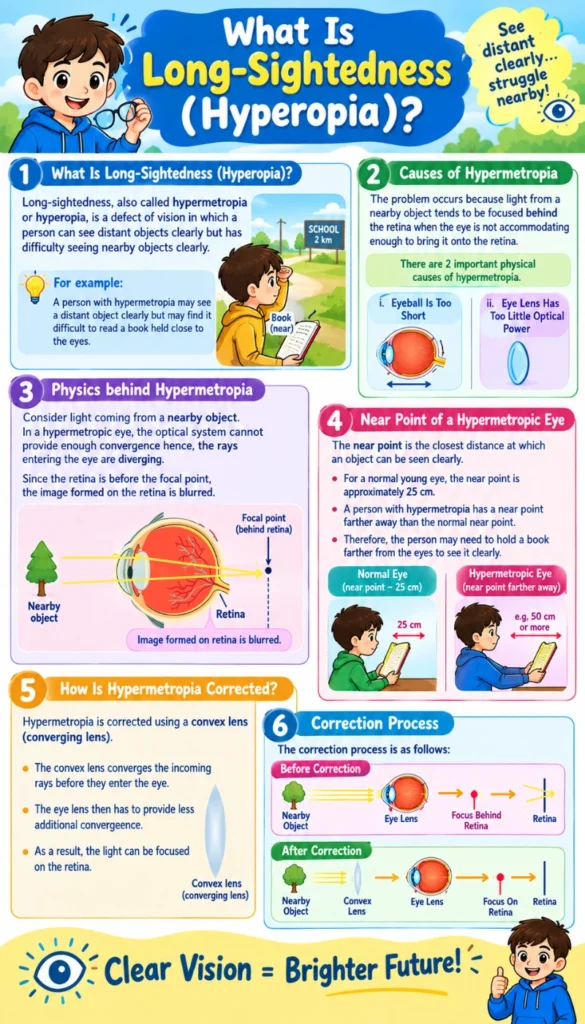
Common Physical Causes
Hypermetropia commonly occurs when:
- The eyeball is too short.
- The optical power of the eye is too weak.
Correcting Lens
Hypermetropia is corrected using a convex lens.
A convex lens is a converging lens. It brings the incoming light rays closer together before they enter the eye, helping the eye focus the image on the retina.
Power of a Correcting Lens for Hypermetropia
A convex lens has a positive focal length.
Therefore, its power is positive.
For example:

It means that the correcting lens has a power of plus two dioptres.
The exact power required depends on the degree of the person’s refractive error.
Myopia vs Hypermetropia
| Feature | Myopia | Hypermetropia |
| Common Name | Short-sightedness | Long-sightedness |
| Clear Vision | Near objects | Distant objects |
| Problem | Distant objects appear blurred | Near objects appear blurred |
| Focus Without Correction | In front of retina | Behind retina |
| Common Physical Cause | Eyeball too long or optical power too strong | Eyeball too short or optical power too weak |
| Correcting Lens | Concave lens | Convex lens |
| Lens Type | Diverging | Converging |
| Lens Power | Negative | Positive |
How Aberration of Lenses and Defects of Vision Different?
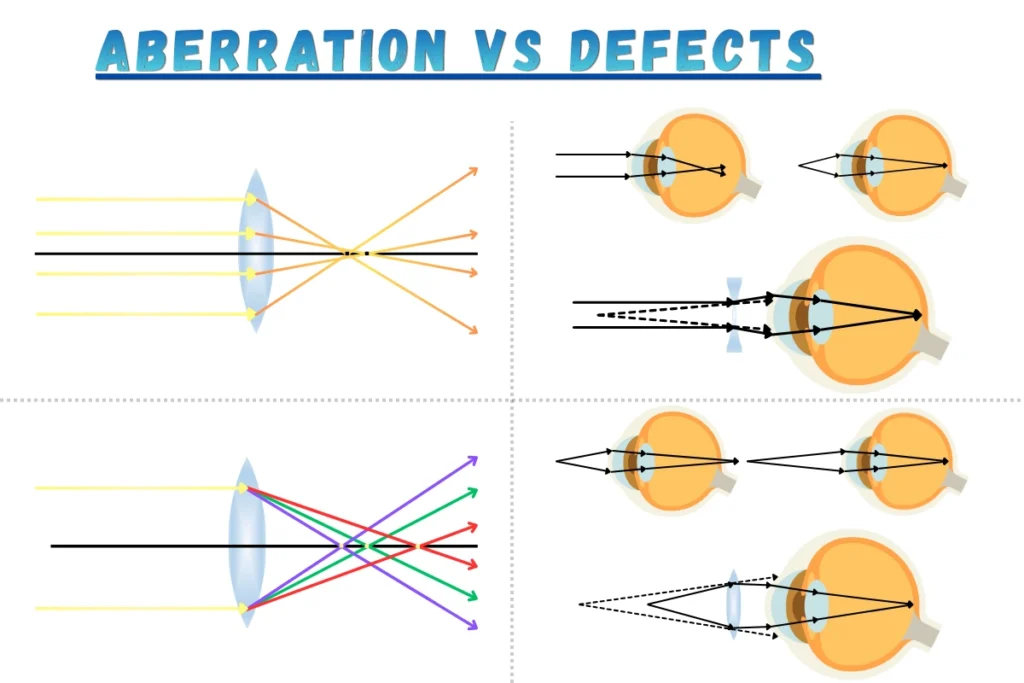
Lens aberrations and defects of vision both involve problems with focusing light, but they are not the same thing.
| Lens Aberration | Defect of Vision |
| Lens aberration is an imperfection in the image produced by an optical lens. | A defect of vision is a problem in the optical system of the human eye. |
| Examples include: Spherical aberration Chromatic aberration | Examples include: Myopia Hypermetropia |
| Correction Spherical aberration can be reduced using appropriate lens shapes and apertures. Chromatic aberration can be reduced using achromatic lens combinations. | Correction Myopia is corrected using a concave lens. Hypermetropia is corrected using a convex lens. |
Quick Revision
- Aberration = optical error in image formation.
- Spherical aberration = different zones of a lens focus rays at different positions.
- Chromatic aberration = different colours focus at different positions.
- Spherical aberration is mainly related to lens shape and ray position.
- Chromatic aberration is mainly related to wavelength and dispersion.
- Myopia = short-sightedness.
- Myopia → image of a distant object forms in front of the retina.
- Myopia → corrected with a concave lens.
- Hypermetropia = long-sightedness.
- Hypermetropia → image of a nearby object tends to form behind the retina.
- Hypermetropia → corrected with a convex lens.
- Concave lens = diverging lens = negative power.
- Convex lens = converging lens = positive power.
Conclusion
Aberrations of lenses and defects of vision are important concepts in optics. They help us understand why real optical systems do not always produce perfect images.
Understanding these concepts provides a strong foundation for studying optics, lenses, refraction, image formation, optical instruments, and human vision.
Frequently Asked Questions
What is aberration of a lens?
Aberration of a lens is an optical error in which a lens does not form a perfectly sharp image because different light rays may not meet at the expected image point.
What are the two important types of lens aberration?
Two important types are spherical aberration and chromatic aberration.
What causes spherical aberration?
Spherical aberration is mainly caused by the spherical shape of lens surfaces. Rays passing through different parts of the lens may focus at different positions.
What causes chromatic aberration?
Chromatic aberration is caused by the dispersion of light. Different wavelengths of light are refracted by different amounts and therefore have different focal lengths.
How can spherical aberration be reduced?
Spherical aberration can be reduced by using a smaller aperture, suitable lens shapes, multiple lens elements, or aspherical lenses.
How can chromatic aberration be corrected?
Chromatic aberration can be reduced using achromatic lens combinations, special low-dispersion glass, multiple lens elements, and, in some cases, digital correction.
What is myopia?
Myopia is a refractive error in which nearby objects are seen clearly, but distant objects appear blurred. Light from distant objects is focused in front of the retina.
Which lens is used to correct myopia?
A concave lens is used to correct myopia. It is a diverging lens and usually has negative power.
What is hypermetropia?
Hypermetropia is a refractive error in which distant objects can generally be seen more clearly than nearby objects. Light from a nearby object tends to be focused behind the retina.
Which lens is used to correct hypermetropia?
A convex lens is used to correct hypermetropia. It is a converging lens and usually has positive power.