
If you are a high school student trying to master fundamentals of 2 types of lenses, you are in the right place. Let us break it down step by step.
Table of Contents
Introduction
Lenses are one of the most important topics in optics. Lenses are everywhere—in eyeglasses, microscopes, telescopes, and even your phone camera. Once you get the basics, everything from glasses to cameras starts making sense. But fundamentally, all lenses fall into two main types:
- Convex Lens (Converging Lens)
- Concave Lens (Diverging Lens)
Understanding how these two behave is the key to mastering optics.
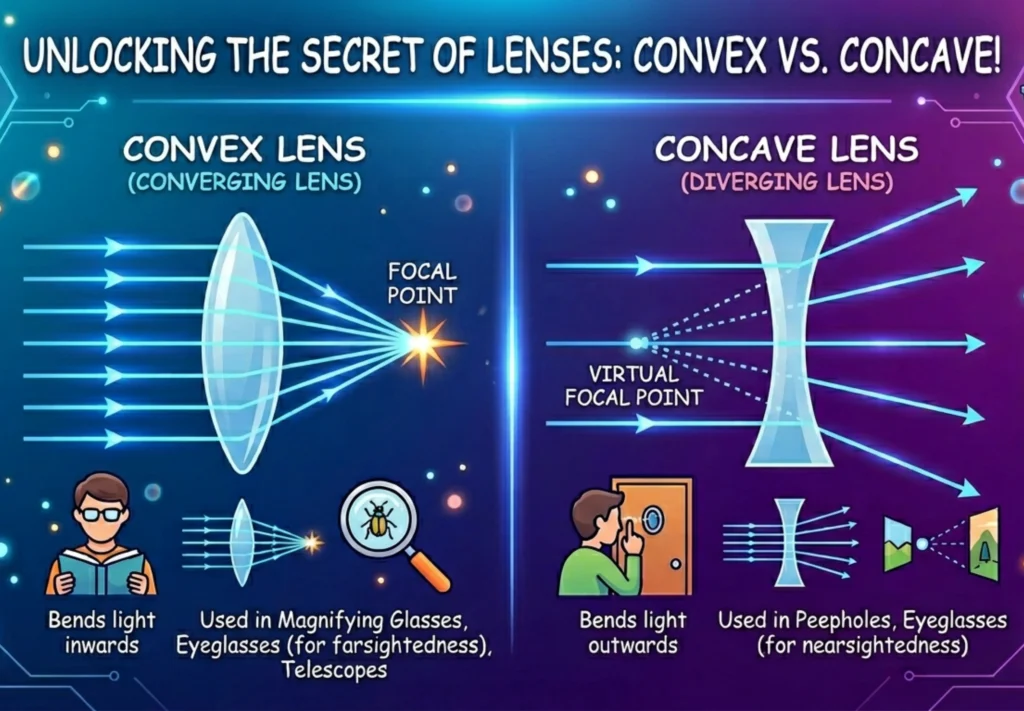
What is a Lens?
A lens can be defined as:
“A transparent material bounded by curved surfaces that bends light when it passes through it”.
This simple definition contains 3 very important ideas:
- transparent material → to allow light to pass through it like glass or plastic
- curved surface → to control how light rays behave, i.e., either converge or diverge light
- bends light → light passes from one medium (air) into another (glass) – aka refraction
The hidden recipe of a lens is not just its transparency, but also because it has a curved shape that causes refraction in a controlled way.
Important Terms Associated with Lenses
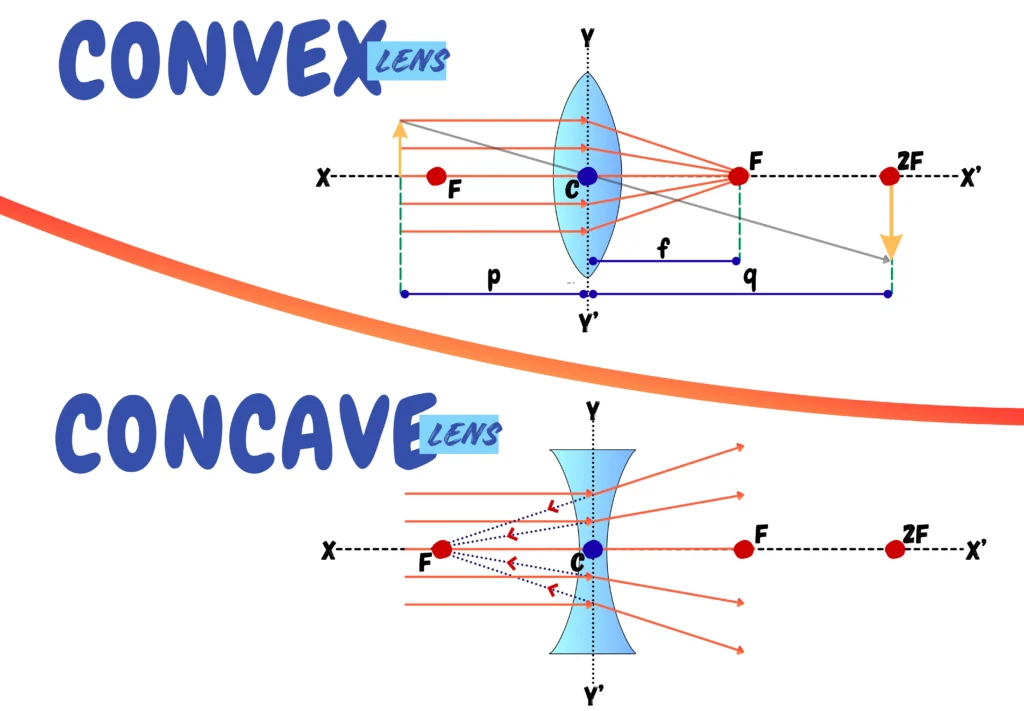
- Principal Axis
 : The straight line passing through the centre of the lens
 - Optical Centre (
 ): The centre point of the lens where light passes without deviation
 - Focus (): The point where parallel rays converge (or appear to diverge from)
- Focal Length (
 ): Distance between optical centre and focus
 - Object Distance (
 ): Distance of object from lens
 - Image Distance (
 ): Distance of image from lens
 : The straight line passing through the centre of the lens
 ): The centre point of the lens where light passes without deviation
 ): The point where parallel rays converge (or appear to diverge from)
Approximate Method of Finding the Focal Length of a Convex Lens
According to this method:
- The light rays originating from a distant object—such as a far-off building—become parallel by the time they reach the lens.
- The parallel rays pass through a convex lens and converge at a single point on the opposite side of the lens due to its refractive properties.
- The specific point of convergence is known as the principal focus and serves as a reliable approximation of the focal length of the lens.
- Adjusting the distance between the lens and the screen controls the sharpness and clarity of the image.
- The nature of the image formed in this setup is:
- Real
- Inverted
- Highly Diminished
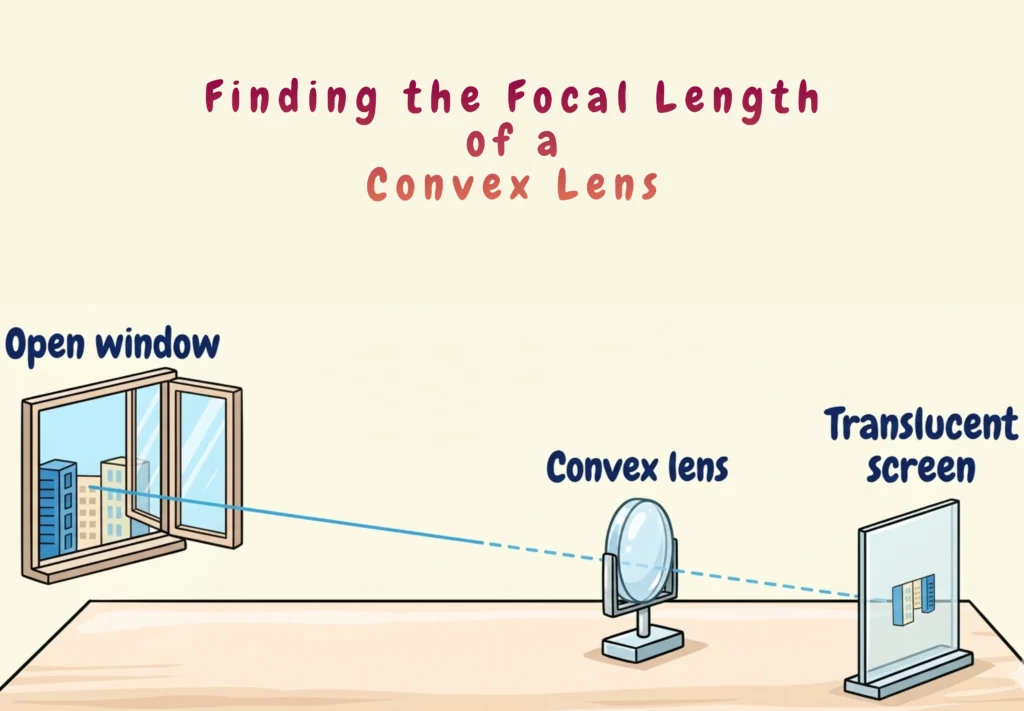
This simple method is a foundational technique in optics for quickly estimating the focal power of converging lenses.
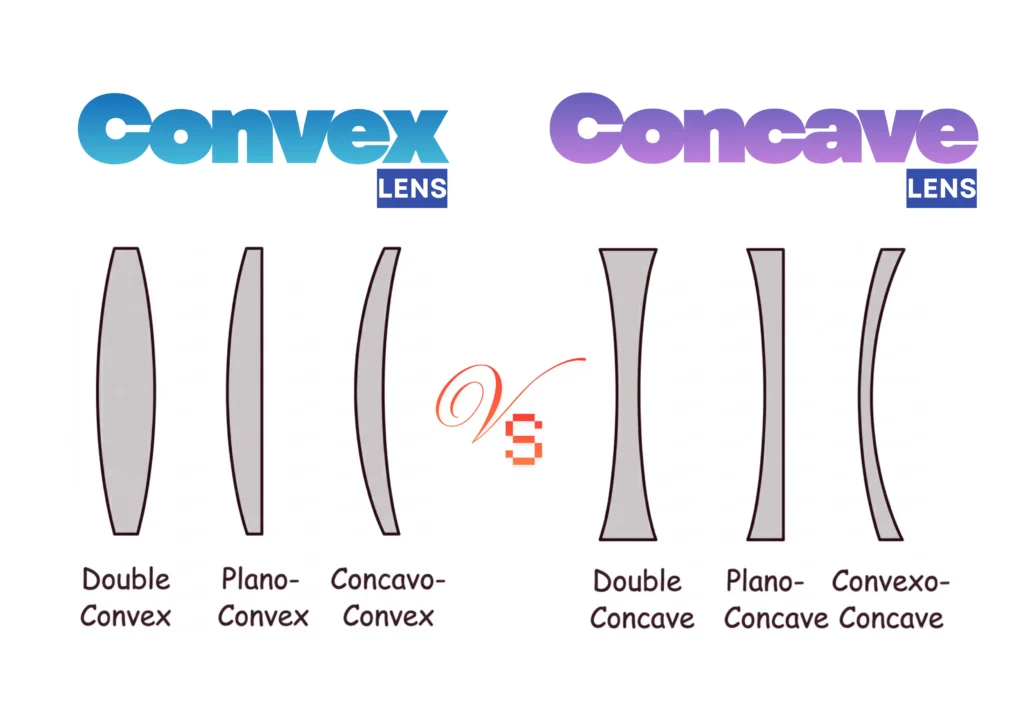
2 Types of Lenses
Mainly, there are 2 types of lenses as shown.
Convex Lens (Converging Lens)
A convex lens is thicker at the centre and thinner at the edges. It converges parallel rays of light to a single point (focus).
How is an Image Formed?
The location of the image can be determined following these steps:
- A ray parallel to the principal axis passes through the focus after refraction
- A ray passing through the optical centre goes straight
- These rays meet to form a real, inverted image (in most cases)
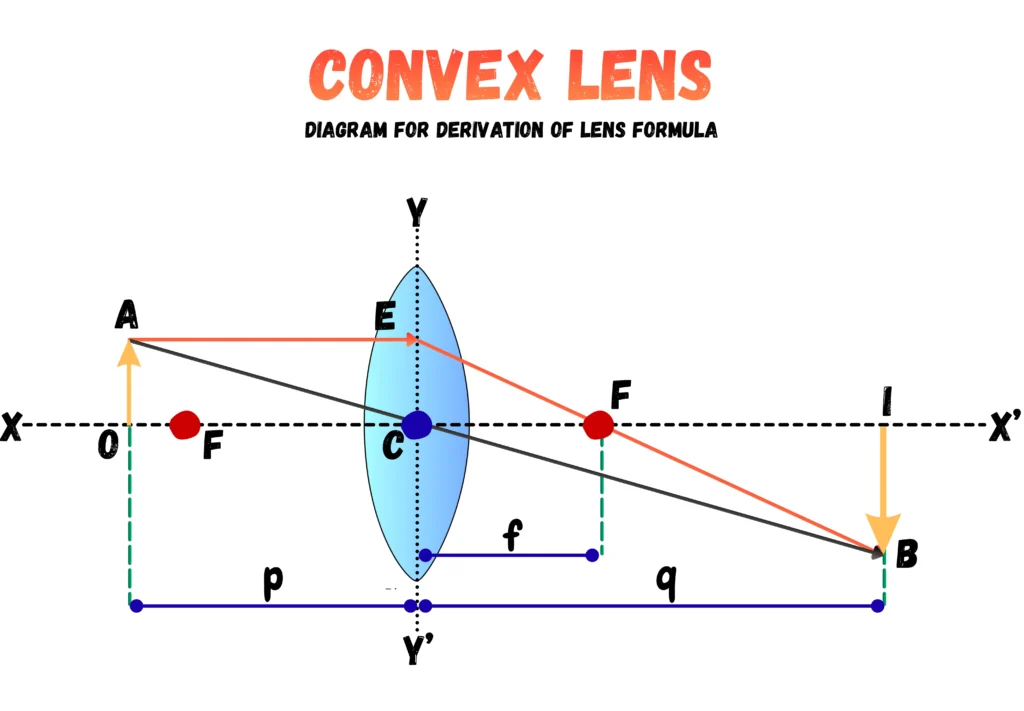
Note
These are also the 3 core steps you need to remember for your examinations.
Convex Lens Formula
To find the image location by lens equation, consider the relationship between object distance ( ), image distance (
 ), and focal length (
 ):
):

Here,
- Object Distance =
- Image Distance =
- Focal Length =
This is known as the lens formula, and it is one of the most important equations in optics.
Derivation of Lens Formula (Convex Lens)
Check out the following file for a detailed derivation.
Applications of Convex Lenses
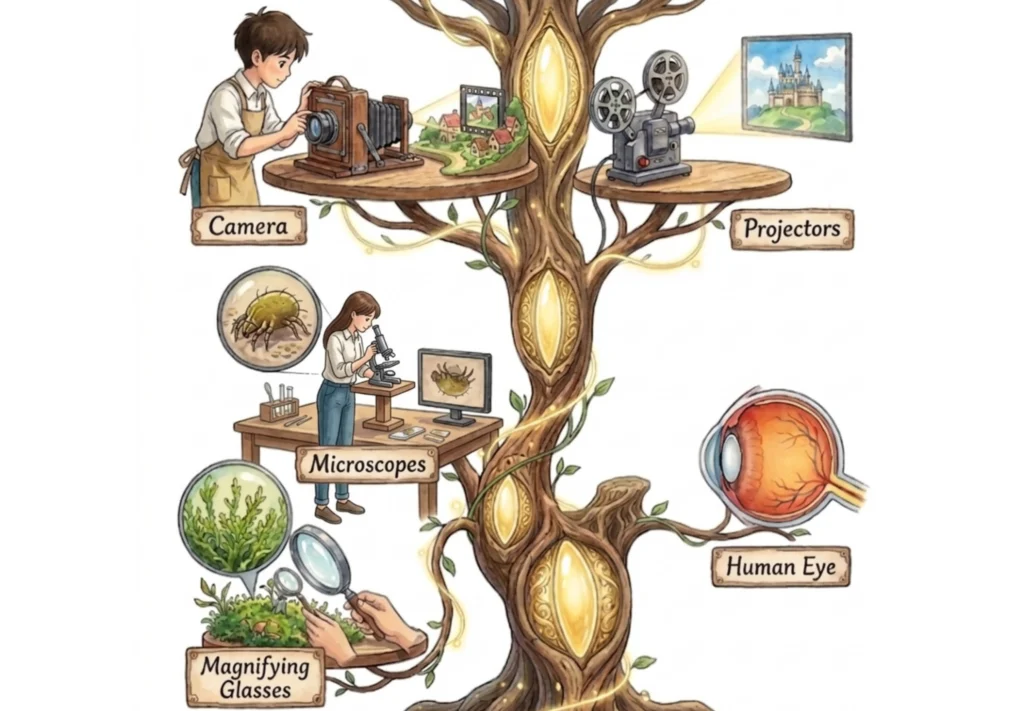
Convex lenses are widely used because they can form real images:
- Cameras
- Projectors
- Microscopes
- Magnifying Glasses
- Human Eye (Natural Lens)
Concave Lens (Diverging Lens)
A concave lens is thinner at the centre and thicker at the edges. It diverges light rays.
How is an Image Formed?
- A ray parallel to the principal axis appears to come from the focus after refraction.
- A ray through the optical centre goes straight
- The rays do not actually meet, but appear to meet behind the lens
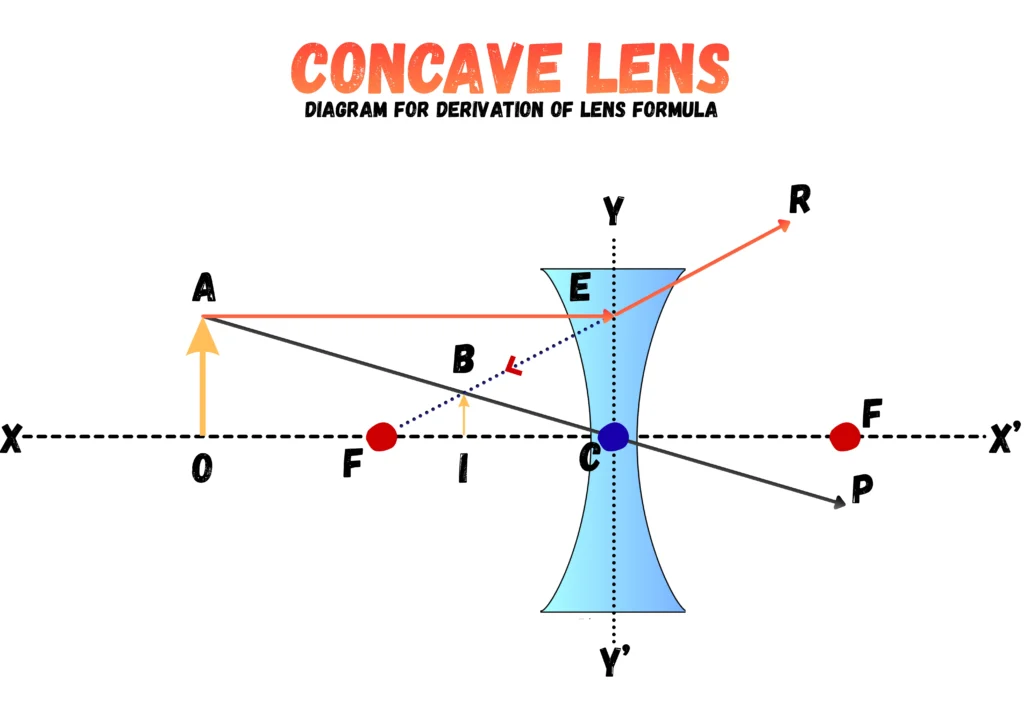
Note
The image is always
- Virtual
- Upright
- Smaller (diminished)
Concave Lens Formula
Interestingly, a concave lens utilises the same lens formula as applied to the convex lens:

Although the formula is the same, the difference comes from the sign convention:
| Quantity | Convex Lens | Concave Lens |
| Positive | Negative |
| Positive (real image) | Negative (virtual image) |
Derivation of Lens Formula (Concave Lens)
Check out the following file for a detailed derivation.
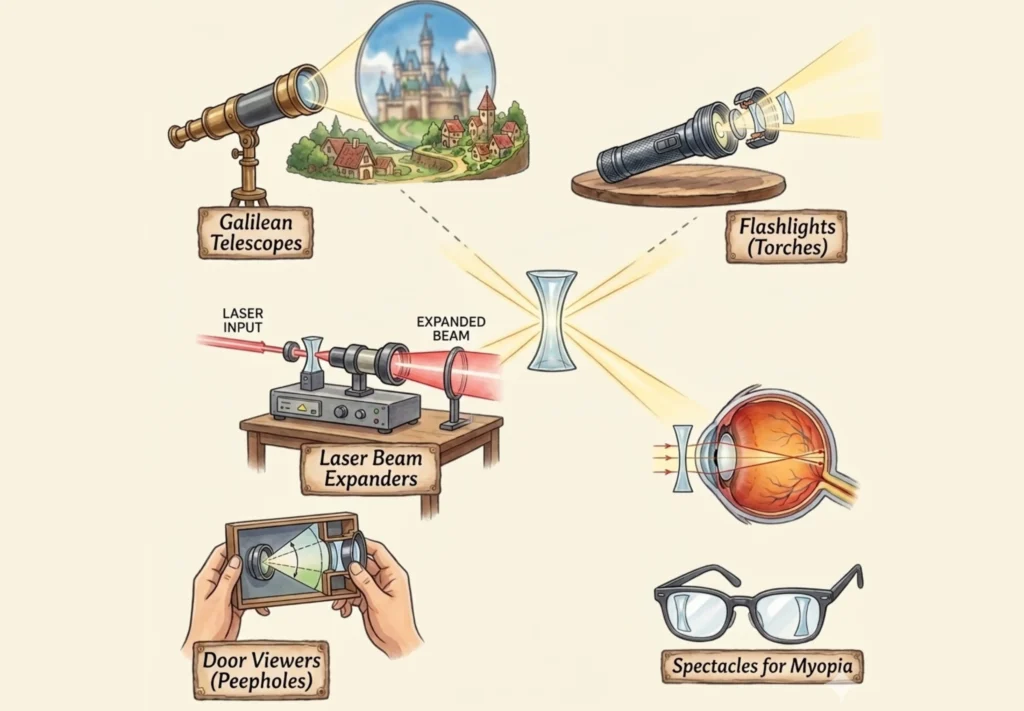
Applications of Concave Lenses
- Galilean Telescopes
- Flashlights (Torches)
- Laser Beam Expanders
- Door Viewers (Peepholes)
- Spectacles for Myopia (Near-Sightedness)
Sign Conventions for Lenses
From an examination point of view, to avoid confusion, we follow standard rules:
- All distances are measured from the optical centre
- Real object/image → positive
- Virtual object/image → negative
- Convex (converging) lens focal length → positive
- Concave (diverging) lens focal length → negative
Key Differences between ‘Convex Lens vs Concave Lens’
| Feature | Convex (Converging) Lens | Concave (Diverging) Lens |
| Shape | Thicker at the centre, thinner at the edges | Thinner at the centre, thicker at the edges |
| Nature of Light | Converges parallel light rays | Diverges parallel light rays |
| Image Formation | Can form real or virtual images | Always forms virtual images |
| Image Orientation | Usually inverted (real image) | Always upright |
| Image Size | Can be enlarged, diminished, or the same size | Always diminished (smaller) |
| Position of Image | Formed on the opposite side (real) or the same side (virtual) | Always formed on the same side as the object |
| Focal Length (f) | Positive | Negative |
| Power (P) | Positive | Negative |
| Ray Behaviour | Rays meet at a focal point | Rays appear to come from a focal point |
| Common Uses | Cameras, microscopes, magnifying glasses, human eye | Spectacles (myopia), peepholes, flashlights |
Linear Magnification
Linear Magnification is defined as:
“The ratio of the height of the image to the height of the object”.
Mathematically, it is represented as:

Where:


Magnification tells us how large or small the image is compared to the object. It is a dimensionless physical quantity.
Interpretation
 → The image is diminished (smaller than the object)
- → The image is enlarged (bigger than the object)
 → The image is the same size as the object
 is negative → The image is inverted (upside down)
- is positive → The image is upright
 → The image is diminished (smaller than the object)
 → The image is enlarged (bigger than the object)
 → The image is the same size as the object
 is negative → The image is inverted (upside down)
Power of a Lens
Power of a Lens is defined as:
“The reciprocal of the focal length of the lens”.
The power of a lens is a measure of how strongly the lens can bend (refract) light rays. A lens with greater power bends light more sharply, while a lens with smaller power bends light less.
Mathematical Formulation
Mathematically, it is represented as follows:

Where:


Unit
It is a physical quantity, and its SI unit is the diopter ( )
)

Key Points
- A convex (converging) lens has positive power (converges light)
- A concave (diverging) lens has negative power (diverges light)
- Shorter focal length → higher power
- Longer focal length → lower power
The power of a lens helps us understand how effectively it can focus or spread light. This idea is important in devices like glasses, cameras, and microscopes.
Conclusion
Lenses form the foundation of optics and many real-world technologies. By understanding the difference between convex and concave (types of) lenses, along with concepts like image formation, lens formula, magnification, and power, you have built a strong base for both exams and practical applications.
The key idea to remember is simple:
- A convex (converging) lens converges light and can form real images
- A concave (diverging) lens diverges light and always forms a virtual image
Keep practicing ‘ray diagrams’ and ‘formulas,’ and soon, lenses will feel like one of the easiest topics in physics!
Frequently Asked Questions (FAQs)
What is the main difference between a convex (converging) lens and a concave (diverging) lens?
A convex (converging) lens converges light rays to a focal point and can form real images, while a concave (diverging) lens diverges light rays and always forms virtual images.
What type of image does a convex (converging) lens form?
A convex (converging) lens can form real and inverted images when the object is beyond the focal point, and a virtual, upright image when the object is placed closer than the focal length.
What type of image does a concave (diverging) lens form?
A concave (diverging) lens always forms a virtual, upright, and diminished image, regardless of the object’s position.
What is the lens formula?
The lens formula is:

It relates the focal length (), object distance (), and image distance () of a lens.
What is magnification in lenses?
Magnification is the ratio of image height to object height:

It tells whether the image is larger, smaller, or the same size compared to the object.
What is the power of a lens?
The power of a lens is the reciprocal of its focal length:

It is measured in diopters () and indicates how strongly a lens bends light.
Why is the focal length positive for convex (converging) lenses and negative for concave (diverging) lenses?
According to the sign convention:
- Convex (converging) lenses have positive focal length because they converge light
- Concave (diverging) lenses have a negative focal length because they diverge light
What are the uses of convex (converging) lenses in daily life?
Convex (converging) lenses are used in:
- Cameras
- Projectors
- Microscopes
- Magnifying glasses
- Human eye (natural lens)
What are the uses of concave (diverging) lenses?
Concave (diverging) lenses are commonly used in:
- Spectacles for myopia (near-sightedness)
- Door viewers (peepholes)
- Flashlights
- Telescopes
How can you find the focal length of a convex lens easily?
You can focus light from a distant object onto a screen. The distance between the lens and the sharp image formed on the screen gives an approximate focal length.