
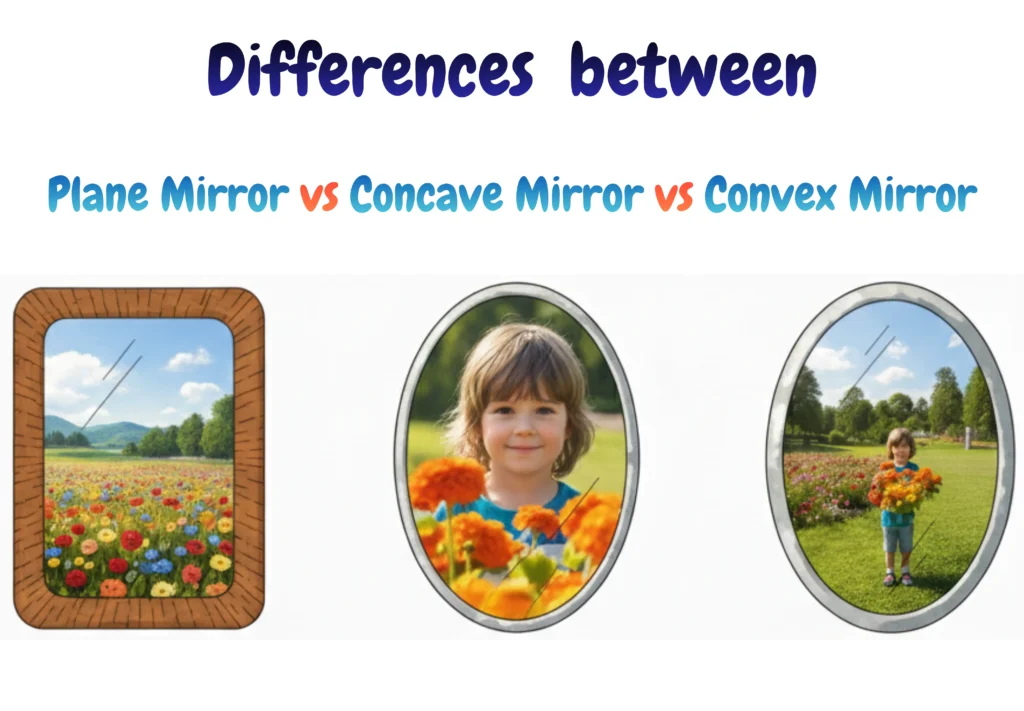
The 3 types of mirrors, “plane mirror vs concave mirror vs convex mirror”, reveal a powerful and elegant interaction between light and curved or flat surfaces.
Table of Contents
Introduction
Mirrors are abundant in our daily lives, yet their underlying physics is often overlooked. From the mirror in a dressing room to the rear-view mirror of a car, each type of mirror manipulates light in a precise manner to form images.
Understanding the differences of mirrors not only clarifies everyday phenomena but also provides insight into technologies ranging from space telescopes to solar concentrators.
Here, we shall focus on the reflection of light from mirrors.
What is a Mirror?
A mirror is a smooth, highly polished surface that reflects most of the light falling on it, forming an image.
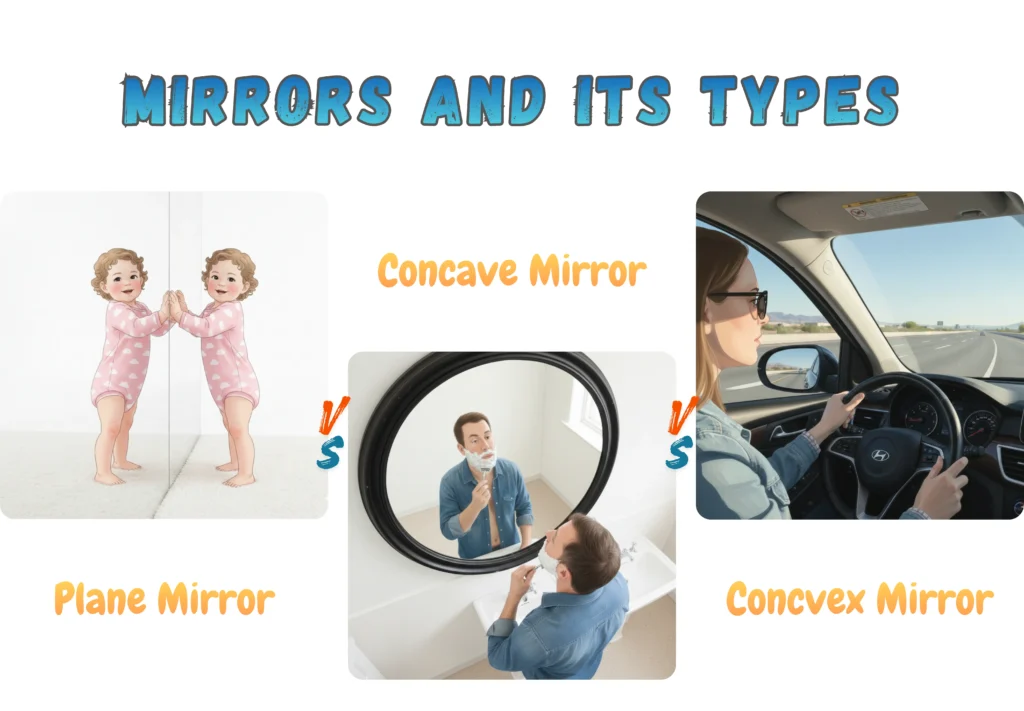
The 3 Types of Mirrors
Generally, there are 3 types of mirrors that are categorised into 2 groups.
1. Curved (Spherical Mirror)
- Curved Inward (Concave Mirror)
- Curved Outward (Convex Mirror)
2. Flat (Plane Mirror)
The type of mirror determines how light rays behave and what kind of image is formed.
Pre-Requisite for Studying Mirrors
Before studying mirrors in detail, you should understand:
- Ray diagrams
- Reflection of Light
- Straight-line propagation of light
- Normal, angle of incidence, and angle of reflection
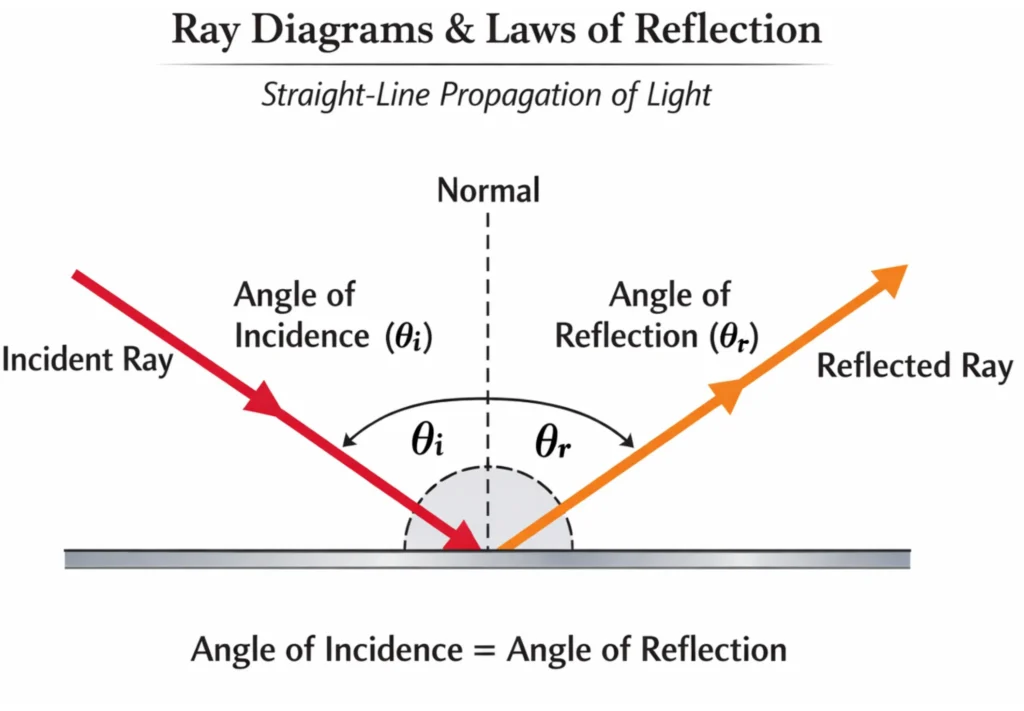
These concepts will help you analyse how images are formed by different mirrors.
Spherical Mirrors
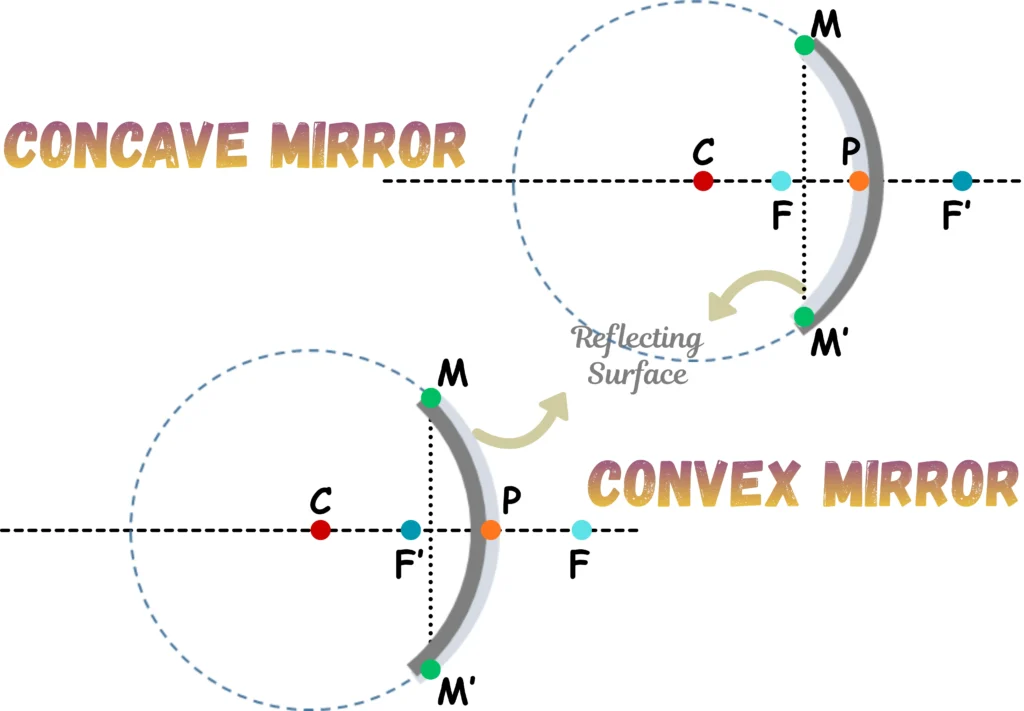
A spherical mirror is a mirror whose reflecting surface is part of a sphere. Based on the curvature of the reflecting surface, spherical mirrors are classified into:
- Concave Mirror – reflecting surface is curved inward
- Convex Mirror – reflecting surface is curved outward
Terms Associated with Spherical Mirrors
| Terms | Definition |
| Centre of Curvature (C) | The centre of the sphere of which the mirror is a part. It is outside the mirror for concave and convex mirrors. |
| Aperture | The diameter of the reflecting surface of a mirror. |
| Pole (P) | The geometrical centre of the mirror surface. |
| Principal Axis | The straight line passing through the pole (P) and the centre of curvature (C). |
| Radius of Curvature (R) | The radius of the spherical surface, i.e., the distance between the pole (P) and the centre of curvature (C).  |
| Principal Focus (F) | The point on the principal axis where parallel rays converge (concave) or appear to diverge (convex) after reflection. |
| Real Focus | A focus where reflected rays actually meet (concave mirror). |
| Virtual Focus | A focus where rays appear to meet but do not actually converge (convex mirror). |
| Focal Length (f) | Distance between the pole (P) and the principal focus (F).  |
Concave Mirror
A concave mirror is a spherical mirror with the reflecting surface curved inward, converging light rays to a real focus.
How a Concave Mirror Forms an Image?
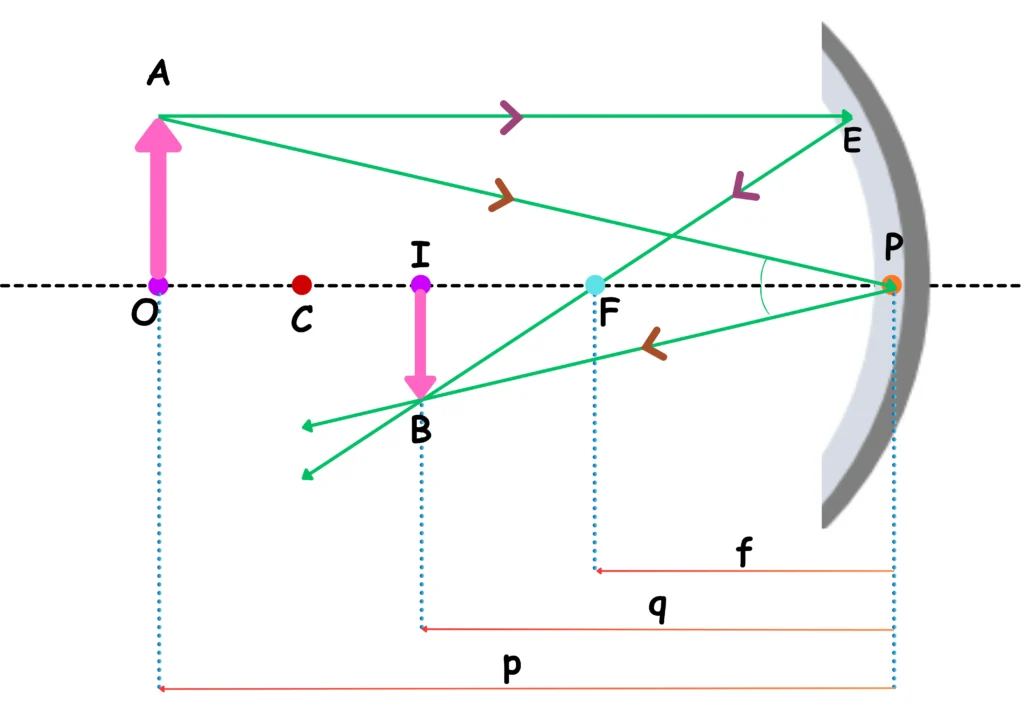
- An object OA is placed in front of the concave mirror.
- A ray AE from point A is parallel to the principal axis. The parallel ray, after reflection (at E), always passes through the principal focus F.
- Another ray APB passes through the pole P of the mirror and follows the law of reflection (i.e., the angle of incidence equals the angle of reflection).
- The two rays AE and AP, after reflection, intersect at B, forming the image IB of the object OA.
Derivation of the Mirror Formula
Consider the concave mirror ray diagram as shown above:
Using Similar Triangles
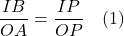
Triangles AOP and BIP are similar:

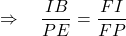
Triangles PEF and IBF are similar:


Using Rectangular Geometry
From quadrilateral AEPF, we know:

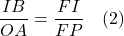
Equating Ratios
Comparing (1) and (2):

Substitute distances:
- Object distance from pole:

- Image distance from pole:

- Focal length:


We know that:

Therefore:
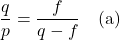
Rearranging




Uses of Concave Mirrors
- Dentistry: Magnified images of teeth.
- Shaving/Make-up Mirrors: Provide magnified, upright images.
- Searchlights & Headlights: Parabolic mirrors focus light into strong beams.
Convex Mirror
A convex mirror is a spherical mirror with the reflecting surface curved outward, causing parallel light rays to diverge.
The reflected rays appear to come from a virtual focus behind the mirror, forming virtual, erect, and diminished images.
How a Convex Mirror Forms an Image?
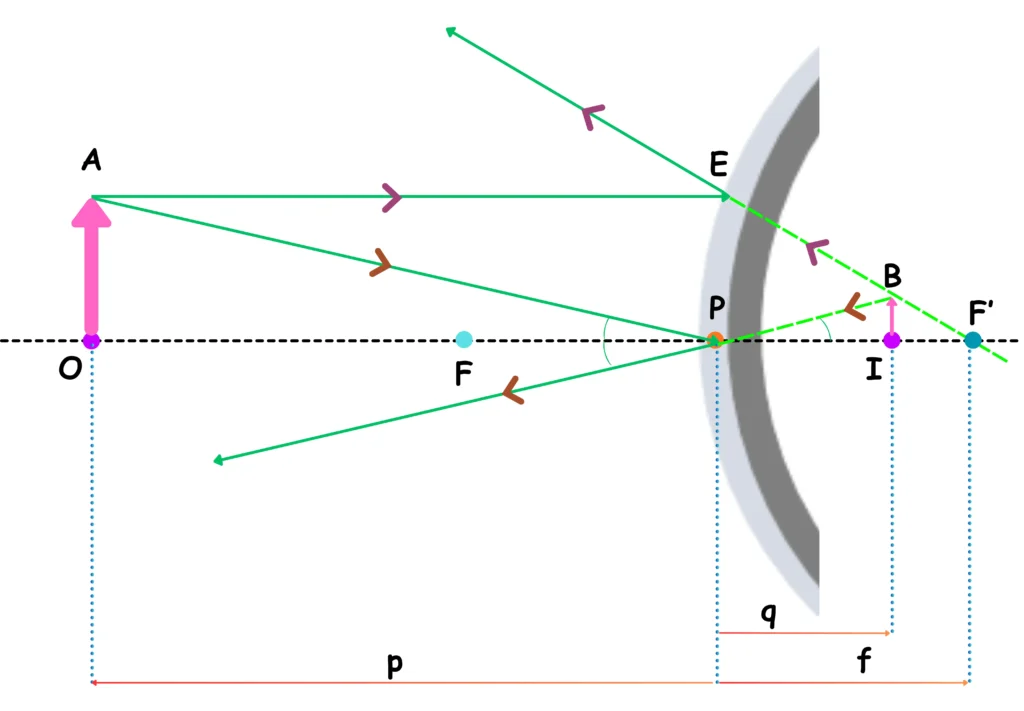
- An object OA is placed in front of the convex mirror.
- A ray AE from point A is parallel to the principal axis. After reflection at E, it diverges, appearing to come from the principal focus F behind the mirror.
- Another ray APC passes through the pole P of the mirror. After reflection, it follows the law of reflection (angle of incidence = angle of reflection) and appears to come from point B behind the mirror.
- The two rays appear to intersect at B, forming the virtual image IB of the object OA.
Derivation of the Mirror Formula
Consider the raw diagram of a convex mirror as shown above:
Using Similar Triangles
Triangles AOP and BIP (imaginary extensions behind the mirror) are similar:
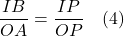
 object height
 image height
 object distance from pole
 virtual image distance behind the mirror
 object height
 image height
 object distance from pole
 virtual image distance behind the mirror
Using Paraxial Geometry
Triangles PEF (formed by the focus, pole, and point on the mirror) and IBF (imaginary triangle to image) are similar under paraxial approximation:

 (from rectangle AEPF)
- (focal length, negative for convex mirror)


Equating Ratios
From (4) and (5):
Substitute distances with sign conventions for convex mirrors:
- Object distance:
- Virtual image distance: (behind mirror, taken as negative)
- Focal length: (negative for convex mirror)

Rearranging




Note: For a convex mirror, f < 0 and q < 0, so the image is virtual and erect.
Uses of Convex Mirrors
- Vehicle Side Mirrors: Provide a wide field of view.
- Road Safety: Convex mirrors at bends help drivers see oncoming traffic.
- Security Mirrors: Installed in shops, warehouses, and streets to observe blind spots.
Plane Mirror
A plane mirror is a mirror that has a perfectly flat reflecting surface. Although its surface has no curvature, it obeys the same laws of reflection as spherical mirrors:

How a Plane Mirror Forms an Image?
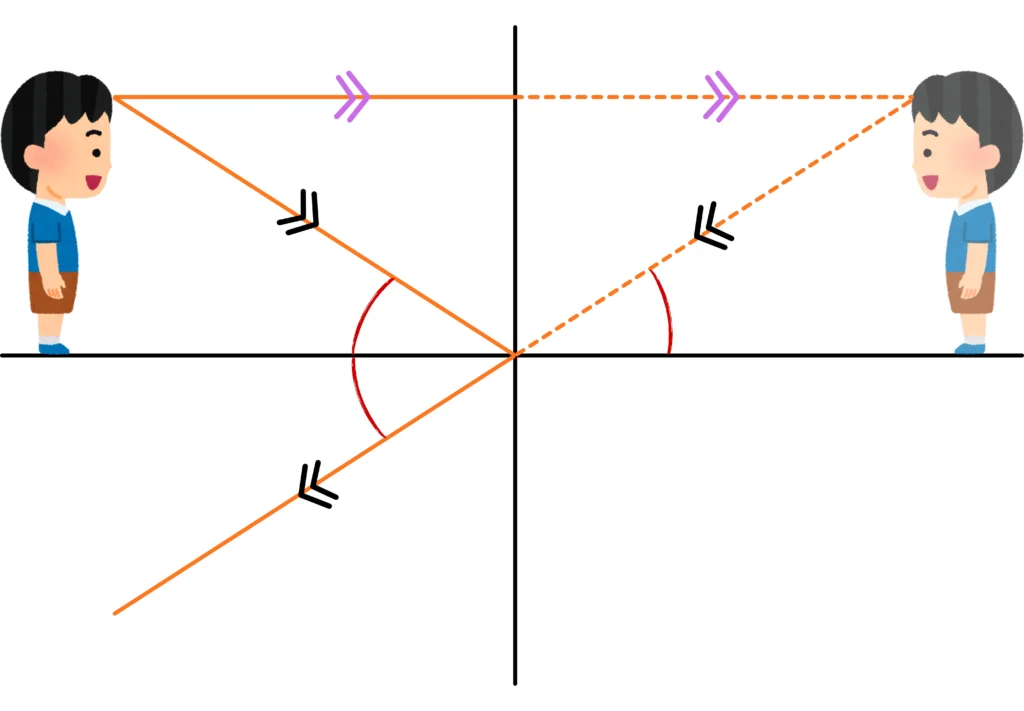
- A ray from point A strikes the mirror at some point P.
- It reflects that the angle of incidence equals the angle of reflection.
- The reflected rays diverge in front of the mirror.
- When these reflected rays are extended backward, they appear to meet at point B behind the mirror.
Thus, IB is the image of object OA. However, the rays do not actually meet behind the mirror; therefore image formed is virtual.
Characteristics of Images Formed by a Plane Mirror
A plane mirror always forms images that are:
- Erect (upright)
- Same size as the object
- Laterally inverted (left-right reversal)
- Virtual (cannot be captured on a screen)
- Located at the same distance behind the mirror as the object is in front
Lateral Inversion
A plane mirror reverses left and right. For example:
- Your right hand appears as the left hand in the mirror.
- Writing appears reversed.
This effect is called lateral inversion.
Why Plane Mirrors Are Useful?
These mirrors are useful because they preserve:
- Size
- Shape
- Proportions
They provide an undistorted, life-size image.
Common Uses of Plane Mirrors
- Kaleidoscopes: Multiple reflections between plane mirrors create symmetrical patterns.
- Personal Grooming: Bathroom and dressing mirrors provide accurate, life-size images.
- Optical Instruments: Used to redirect light paths without changing image characteristics.
- Periscopes: Two plane mirrors placed at 45° reflect light to allow viewing over obstacles (used in submarines).
The Mathematics behind a Plane Mirror
To apply the mirror formula:

Since we treat a plane mirror as a spherical mirror with an infinite radius of curvature. So,

Hence,

Now, the mirror formula becomes:


Which simplifies to:

This confirms that the image is virtual and located symmetrically behind the mirror.
Linear Magnification
The ratio between the height (or size) of the image formed by a mirror and the height (or size) of the object is called Linear Magnification.
It is a dimensionless quantity and represented by m.
Mathematical Formulation
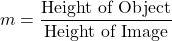
With the help of equation (1), this can also be expressed in terms of distances:

In essence,

According to equation (a) in the mirror formula derivation:
Hence,

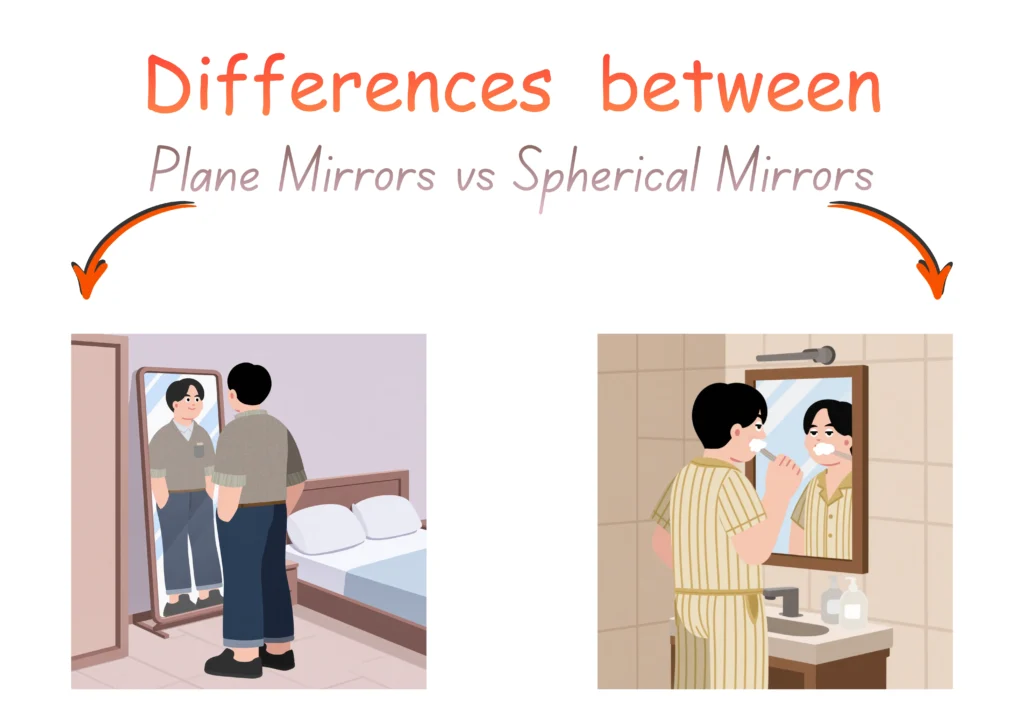
Differences between Plane Mirrors and Spherical Mirrors
| Feature | Plane Mirror | Spherical Mirror |
| Surface Shape | Flat reflecting surface | Curved reflecting surface (part of a sphere) |
| Types | Only one type | Two types: Concave and Convex |
| Focal Length | Infinite | Finite |
| Image Formation | Always virtual and the same size | Can form real or virtual images |
| Magnification | Always 1 | Can be >1, <1, or =1 |
| Convergence/Divergence | Neither converges nor diverges light | Can converge or diverge light |
Differences between a Concave Mirror and a Convex Mirror
| Feature | Concave Mirror | Convex Mirror |
| Reflecting Surface | Curved inward | Curved outward |
| Nature of Mirror | Converging mirror | Diverging mirror |
| Focus | Real focus (in front of the mirror) | Virtual focus (behind the mirror) |
| Image Type | Real or virtual (depends on object position) | Always virtual |
| Image Orientation | Can be inverted or upright | Always upright |
| Magnification | Can magnify or diminish | Always diminished |
| Field of View | Narrow | Wide |
| Common Uses | Shaving mirrors, dentists, and headlights | Side mirrors, security mirrors |
Differences between Plane Mirror vs Concave Mirror vs Convex Mirror
| Feature | Plane Mirror | Concave Mirror | Convex Mirror |
| Surface | Flat | Curved inward | Curved outward |
| Focal Length | Infinite | Finite (positive under sign convention) | Finite (negative under sign convention) |
| Nature | Neither converging nor diverging | Converging | Diverging |
| Image Type | Always virtual | Real or virtual | Always virtual |
| Image Size | Same as object | Enlarged, same, or diminished | Always diminished |
| Image Orientation | Upright | Inverted (real) / Upright (virtual) | Upright |
| Field of View | Normal | Limited | Wide |
| Magnification (m) | 1 | Can be >1, =1, or <1 | Always <1 |
| Applications | Dressing mirrors | Dentistry, shaving, and headlights | Vehicle mirrors, security mirrors |
Conclusion
Mirrors may look simple, but they follow clear rules of physics. Each type of mirror changes light differently. For instance;
- A plane mirror forms an upright virtual image and the same size as the object.
- A concave mirror can form real or virtual images. It can magnify objects or focus light.
- A convex mirror always forms a virtual, upright, and smaller image. It gives a wide field of view.
From dressing mirrors to car mirrors and headlights, the same physics is working. By understanding how these mirrors reflect light, we can explain many everyday things.
Frequently Asked Questions (FAQs)
What are the three types of mirrors?
The three types of mirrors are:
- Plane mirror (flat surface)
- Concave mirror (curved inward)
- Convex mirror (curved outward)
Each type reflects light differently and forms different kinds of images.
What kind of image does a plane mirror form?
A plane mirror always forms an image that is:
- Virtual
- Upright (erect)
- Same size as the object
- Laterally inverted (left-right reversed)
- At the same distance behind the mirror as the object is in front
What is the difference between concave and convex mirrors?
A concave mirror converges light and can form real or virtual images depending on the object position.
A convex mirror diverges light and always forms virtual, upright, and diminished images with a wide field of view.
What is the mirror formula?
The mirror formula is:
Where:
 focal length
 object distance
 image distance
 focal length
 object distance
 image distance
This formula applies to plane (with ), concave, and convex mirrors.
Why does a concave mirror sometimes form a real image?
A concave mirror forms a real image when the object is placed beyond its focal point. Reflected rays actually meet in front of the mirror, allowing the image to be projected on a screen.
Why are convex mirrors used as vehicle side mirrors?
Convex mirrors provide:
- A wide field of view
- Upright images
- Smaller images of objects
This helps drivers see more area behind them, improving safety.
What is linear magnification in mirrors?
Linear magnification (m) is the ratio of image height to object height. It can also be expressed as:

 → enlarged image
 → same size
- → diminished image
 → enlarged image
 → same size
 → diminished image
What is lateral inversion?
Lateral inversion is the left-right reversal seen in a plane mirror. For example, your right hand appears as your left hand in the mirror.
What is the focal length of a plane mirror?
A plane mirror has an infinite radius of curvature, so its focal length is infinite. This is why it neither converges nor diverges.
Where are concave mirrors commonly used?
Concave mirrors are used in:
- Shaving and makeup mirrors (to magnify)
- Solar concentrators
- Vehicle headlights
- Dentist mirrors
- Searchlights
They are useful because they can focus light or enlarge images depending on object placement.