
Understand “what is a prism?” and how the refraction through a prism takes place. Moreover, explore the dispersion of light through a prism.
Table of Contents
Introduction
Light behaves in fascinating ways when it interacts with transparent materials. One of the most important optical devices used to study and manipulate light is the prism.
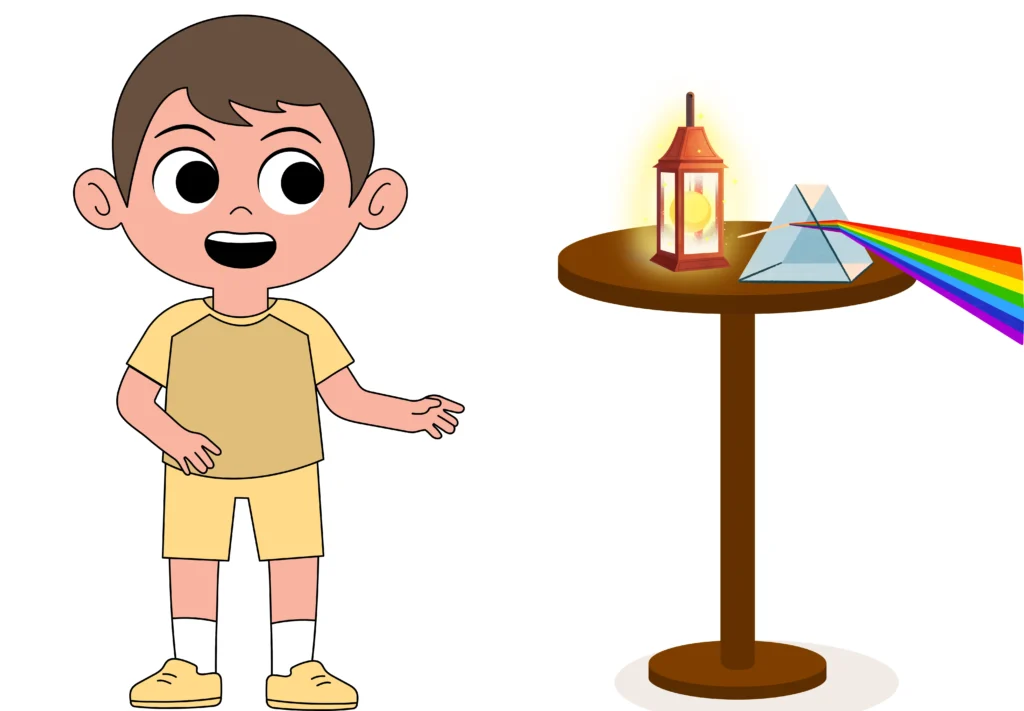
Prisms are widely used in scientific instruments, cameras, binoculars, and even in demonstrations of the beautiful spectrum of colours in white light.
Refraction through a Prism
A prism changes the direction of light through the process of refraction. It happens because the light passes from one medium into another with a different optical density.
Structure of a Prism
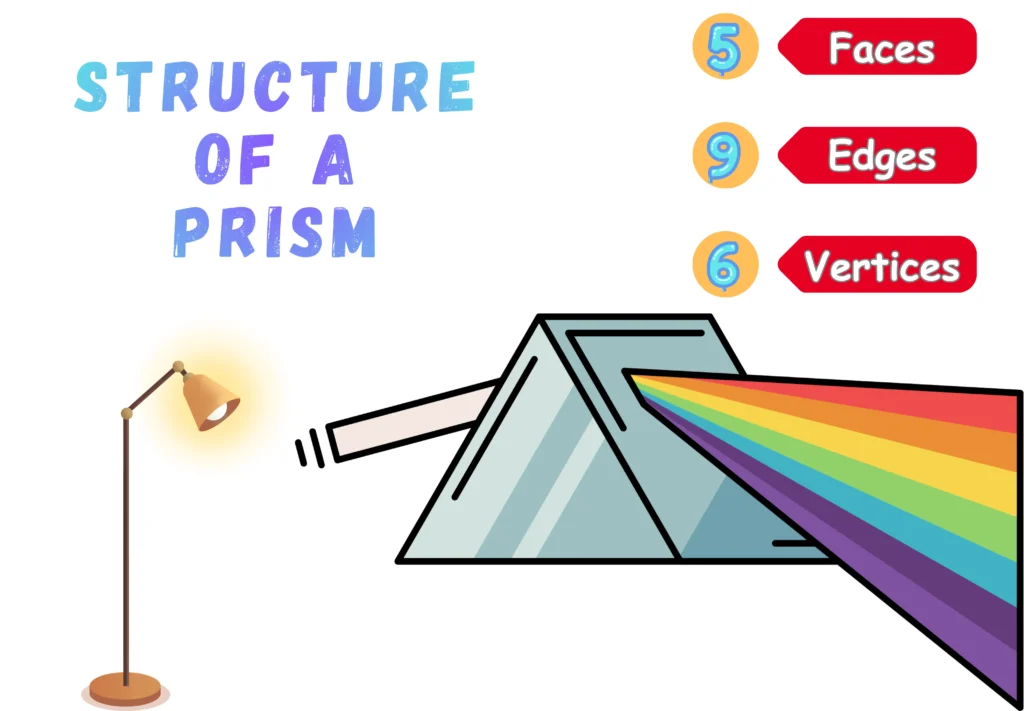
A prism is a transparent optical element usually made of glass or another clear material. A typical triangular prism has:
- 2 triangular faces
- 3 rectangular faces
The triangular faces act as the refracting surfaces, where light enters and exits the prism.
How Light Passes Through a Prism
When a ray of light passes through a prism, it undergoes two refractions.
Step 1: Entry Refraction
When light travels from air into glass, it moves from a less dense medium to a denser medium. As a result, the light ray bends toward the normal.
Step 2: Travel inside the Prism
After entering the prism, the light ray travels through the glass toward the second refracting surface.
Step 3: Exit Refraction
When the light ray leaves the prism (moving from glass to air), it travels from a denser medium to a less dense one. This causes the ray to bend away from the normal.
These two refractions together change the overall direction of the light ray.
Angle of the Prism
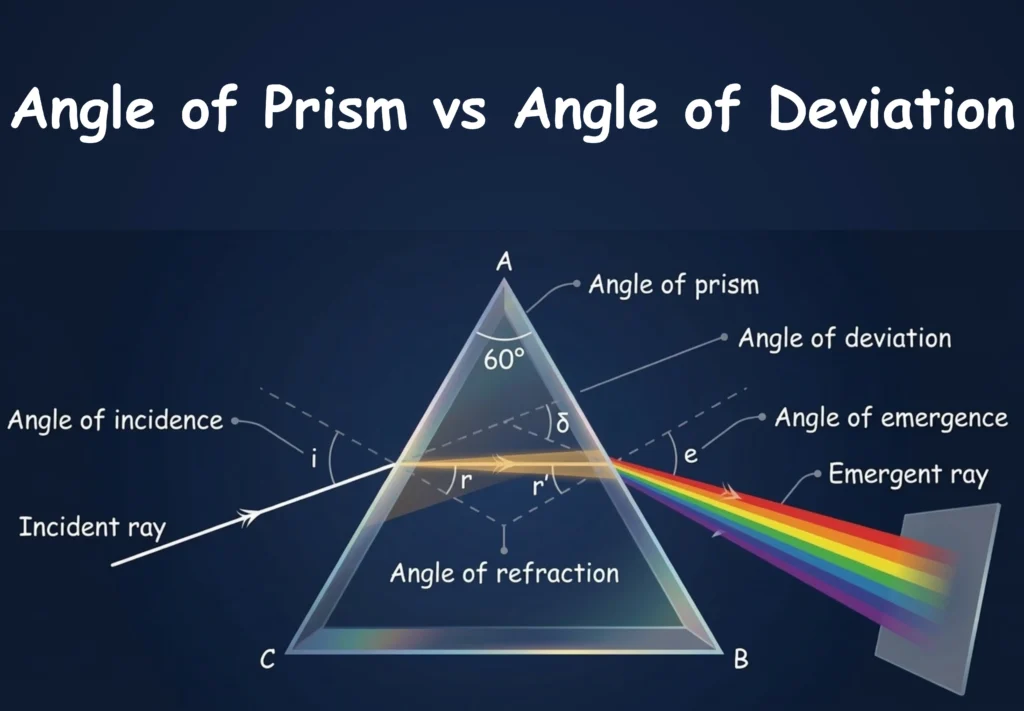
The angle between the two refracting surfaces of a prism is called the angle of the prism. It is represented by  (usually
  ).
).
This angle determines how strongly the prism bends incoming light. Larger prism angles generally produce greater changes in the direction of light.

Angle of Deviation
When a light ray emerges from a prism, its direction is different from the direction in which it originally entered. This is called the angle of deviation and is defined as:
“The angle of deviation ( ) is an angle between the original direction of the incident ray and the final direction of the emergent ray”.
In simple terms, the deviation tells us how much the prism has bent the light ray.
Variation of Deviation
The amount of deviation depends on the angle of incidence (the angle at which light enters the prism).
As the angle of incidence increases, 3 important things happen:
- The deviation initially decreases
- It reaches a minimum value
- Then it increases again
This behaviour is very important in optical measurements.
Angle of Minimum Deviation
The smallest possible deviation produced by a prism is called the angle of minimum deviation. It is represented by  .
.
At this special position:
- The path of the light ray inside the prism becomes symmetrical.
- The angles of refraction at both prism faces become equal.
This symmetrical condition allows scientists to calculate the refractive index of the prism material.
Formula for Refractive Index
The refractive index of the prism material is calculated using the relationship between the prism angle and the minimum deviation.
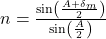
Where:



This formula is widely used in laboratory experiments to determine the refractive index of transparent materials.
Dispersion of Light
One of the most beautiful effects produced by a prism is the dispersion of light.
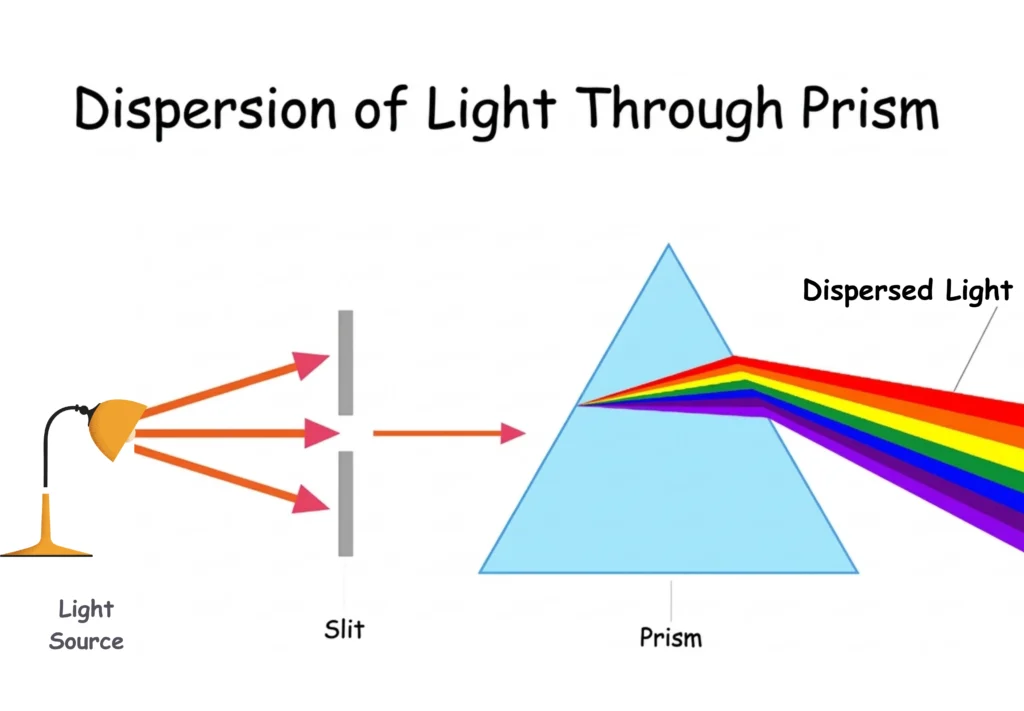
What is Dispersion?
When white light passes through a prism, it splits into its different component colours. This phenomenon is called dispersion of light.
The band of colours produced is known as the solar spectrum.
Why Dispersion Occurs
Dispersion occurs because different colours of light travel at slightly different speeds in glass. As a result, each colour refracts (bends) by a different amount when passing through the prism.
| Property | Red | Violet |
| Amount of Bending | Least | Most |
| Wavelength (nm) | Longest (620 – 750) | Shortest (380 – 450) |
| Frequency (Hz) | Lowest (4.0 × 10¹⁴ – 4.8 × 10¹⁴) | Highest (6.7 × 10¹⁴ – 7.9 × 10¹⁴) |
| Speed in Glass | Fastest | Slowest |
Order of Colours in the Spectrum
The colours produced by dispersion appear in a specific order:
Red → Orange → Yellow → Green → Blue → Indigo → Violet
This sequence is commonly remembered using the acronym: ROYGBIV
Totally Reflecting Prisms
Prisms can also be designed to use total internal reflection instead of mirrors.
These are known as totally reflecting prisms and are widely used in optical devices. Unlike mirrors, these totally reflecting prisms produce very efficient reflections with minimal light loss.
90° Reflection
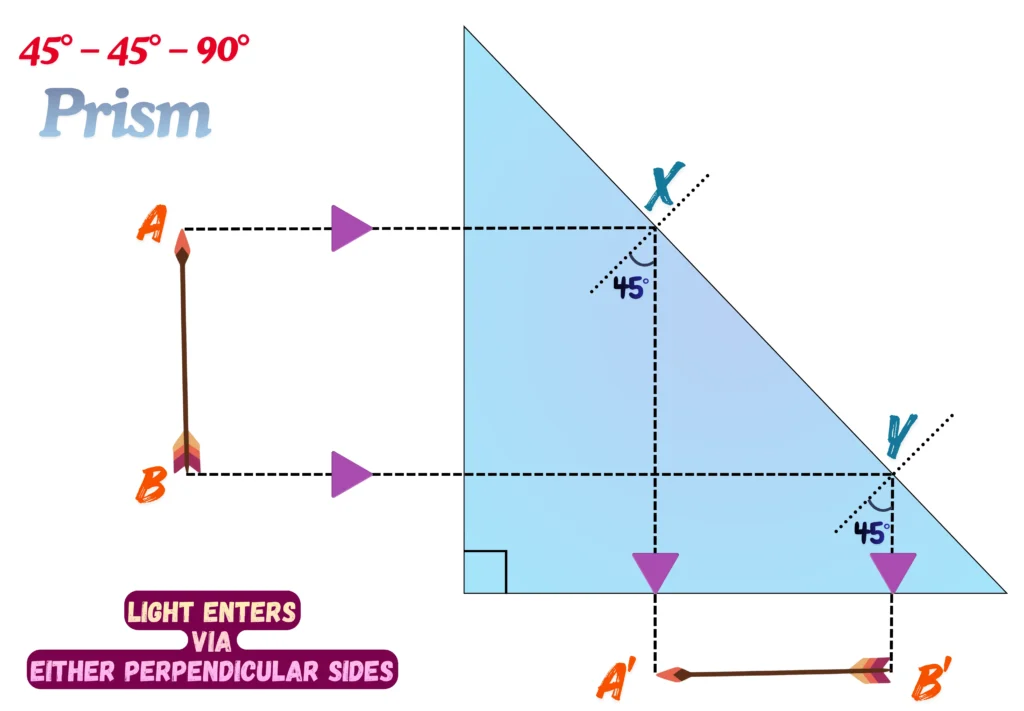
A 45°–45°–90° prism can reflect light by 90 degrees. The process works as follows:
- Light enters one face normally (without bending).
- It strikes the hypotenuse at an angle of 45°.
- Since this angle is greater than the critical angle (about 42° for glass), total internal reflection occurs.
As a result, the ray is reflected through 90°.
Applications
This principle is used in:
- Periscopes
- Various optical instruments
180° Reflection
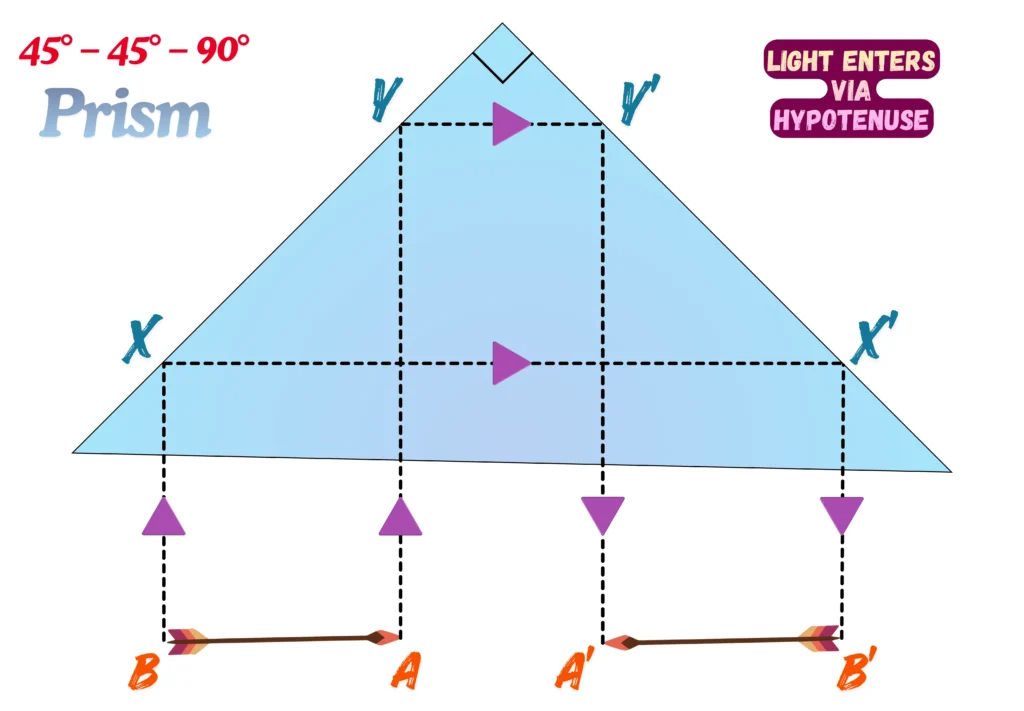
If light enters through the hypotenuse of the prism:
- The ray undergoes two total internal reflections.
- It emerges parallel to the original ray but reversed in direction.
Applications
This arrangement is used in:
- Binoculars
- Camera systems
- Optical imaging devices
Conclusion
Prisms play an important role in optics. They control the direction and behaviour of light and help scientists to understand the properties of light through processes such as:
- Refraction
- Deviation
- Dispersion
Prisms also help to develop many important optical instruments. In a nutshell, from splitting white light into a colourful spectrum to guiding light through complex optical systems, the prism remains one of the most powerful tools in the study of light.
Frequently Asked Questions (FAQs)
What is a prism in physics?
A prism is a transparent optical element usually made of glass or plastic with flat, polished surfaces that refract light. It typically has two triangular faces and three rectangular faces. Prisms are used to bend, reflect, or split light into its component colours in optical instruments and experiments.
How does a prism refract light?
A prism refracts light when it passes from air into glass and then back into air. The ray bends toward the normal when entering the prism and away from the normal when leaving it. These two refractions change the direction of the light ray.
What is the angle of deviation in a prism?
The angle of deviation is the angle between the original direction of the incident ray and the final direction of the emergent ray after passing through a prism. It measures how much the prism bends the light ray.
What is the angle of minimum deviation?
The angle of minimum deviation is the smallest possible angle through which a prism can deviate light. At this position, the light path inside the prism becomes symmetrical, and the angles of refraction at both prism faces are equal.
What is the formula for the refractive index of a prism?
The refractive index of a prism material can be calculated using the prism angle and minimum deviation.
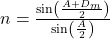
Where n is the refractive index, A is the prism angle, and Dₘ is the angle of minimum deviation.
What is the dispersion of light?
Dispersion of light is the phenomenon in which white light splits into its component colours when it passes through a prism. This happens because different wavelengths of light refract by different amounts in glass.
Why does a prism split white light into colours?
A prism splits white light because different colours have different wavelengths and speeds in glass. As a result, each colour refracts at a different angle. Red bends the least, while violet bends the most, producing a spectrum.
What is the order of colours in the spectrum?
The colours in the visible spectrum appear in the order:
Red → Orange → Yellow → Green → Blue → Indigo → Violet
This sequence is commonly remembered using the acronym ROYGBIV.
Why does violet light bend more than red light in a prism?
Violet light bends more because it has a shorter wavelength and higher frequency, which causes it to slow down more in glass compared to red light. This results in greater refraction and a larger deviation.
What are totally reflecting prisms used for?
Totally reflecting prisms use total internal reflection instead of mirrors to reflect light efficiently. They are commonly used in periscopes, binoculars, cameras, microscopes, and other optical instruments because they produce brighter images with minimal light loss.