
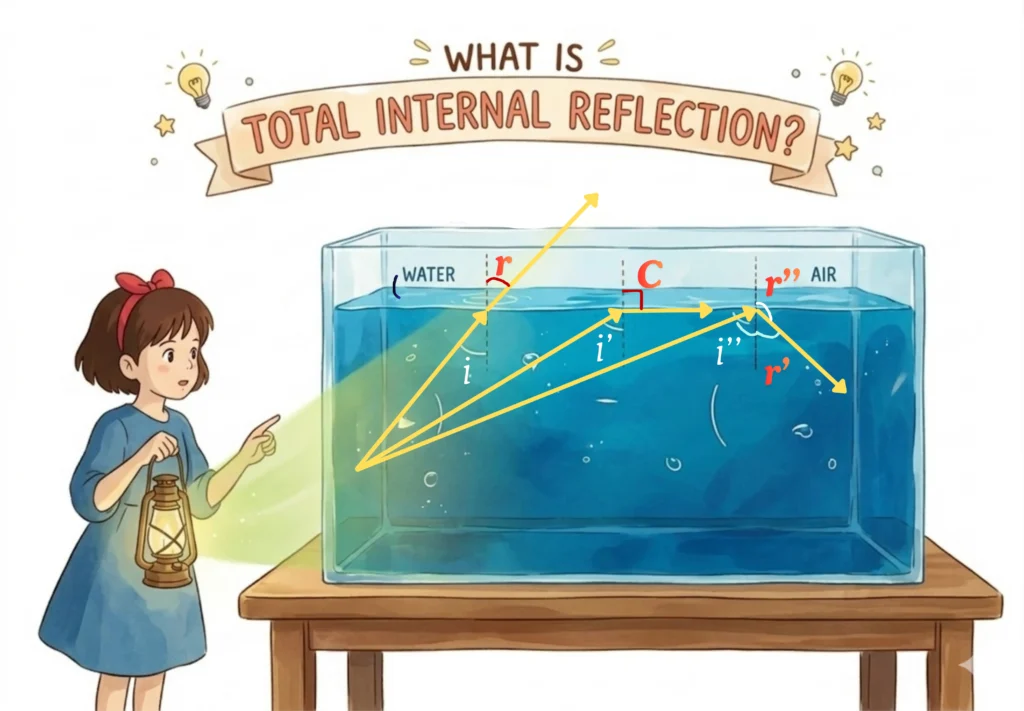
What is Total Internal Reflection? Discover how light behaves between different media and the science behind total internal reflection (TIR).
Table of Contents
Introduction
TIR is one of the most remarkable phenomena in optics. It explains many interesting optical effects observed in nature and technology, including the formation of mirages on hot roads.
However, to understand TIR, we first need to understand how light behaves when it travels between different media.
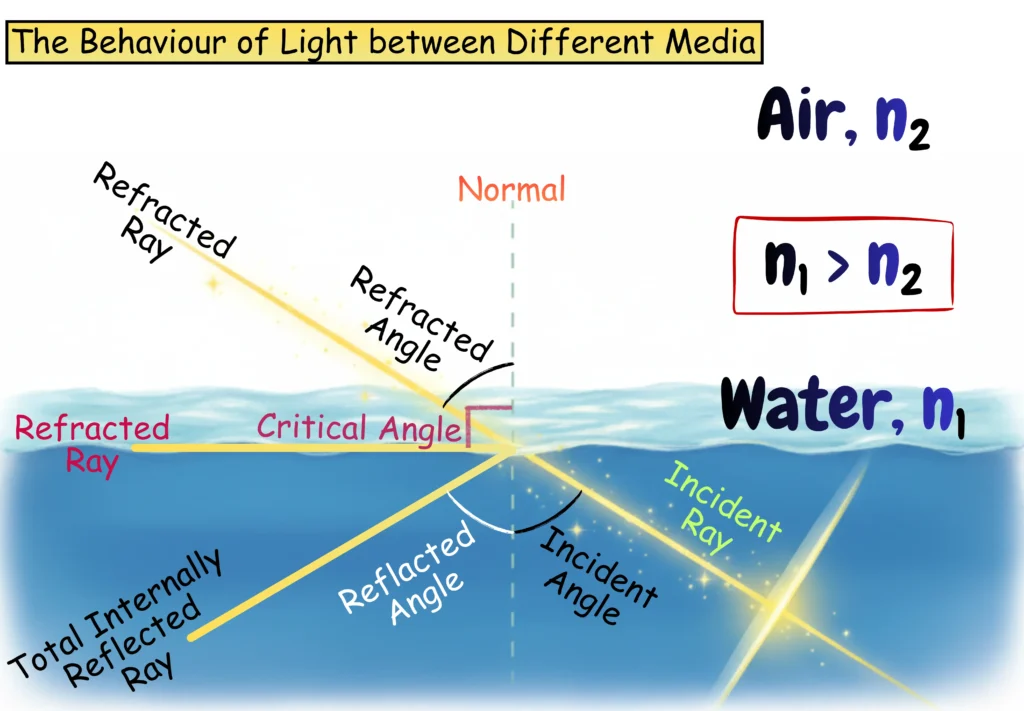
When light passes from one medium to another—such as from air to water or glass—its speed changes. This change in speed causes the light ray to bend at the boundary between the two materials.
The bending of light is known as refraction, and it depends on the optical density and refractive index of the media involved.
Let us try to understand how light behaves when it travels from one material to another.
Refraction of Light
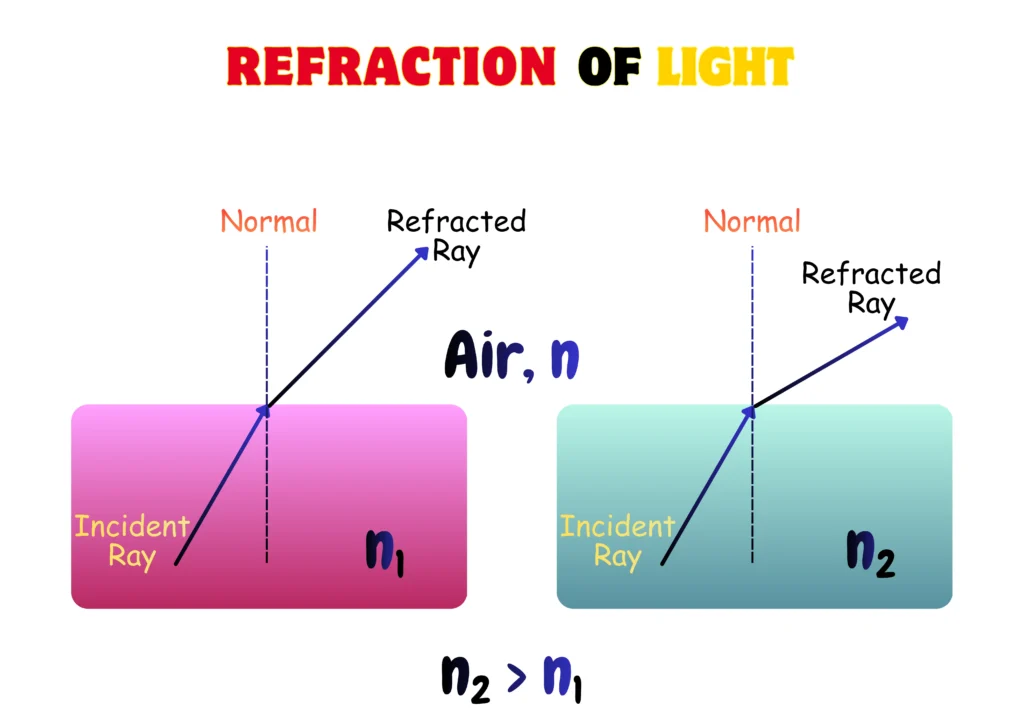
Refraction is the bending of light as it passes from one medium into another with a different optical density. This occurs because light travels at different speeds in different materials.
Optical Density
It is the property of a medium that determines how much it reduces the speed of light passing through it.
- A medium in which light travels more slowly is said to be optically denser, while a medium in which light travels faster is optically rarer.
- In optics, it is related to the refractive index of the medium.
Thus, it is inversely proportional to the speed of light in the medium:

Direction of Bending
The direction in which light bends depends on the optical densities of the two media:
| Situation | Direction of Bending |
| Rarer → Denser (air → glass) | Light bends toward the normal |
| Denser → Rarer (glass → air) | Light bends away from the normal |
The normal is an imaginary line drawn perpendicular to the surface at the point where the light ray strikes.
Example
For example:
- Light travels fastest in a vacuum
- Slightly slower in the air
- Slower still in water
- Even slower in glass
When light enters a material where it travels more slowly, its direction changes.
Refractive Index
The extent to which light bends when entering a medium depends on the refractive index of that material.
The refractive index  is defined as:

Typical values of include:
| Medium | Refractive Index |
| Air | ~1.0003 |
| Water | ~1.33 |
| Glass | ~1.5 |
A higher refractive index means light travels more slowly in that material.
Total Internal Reflection
TIR is one of the most important phenomena in optics. It occurs when light attempts to move from a denser medium into a rarer medium.
Increasing the Angle of Incidence
Imagine a beam of light travelling from glass into air.
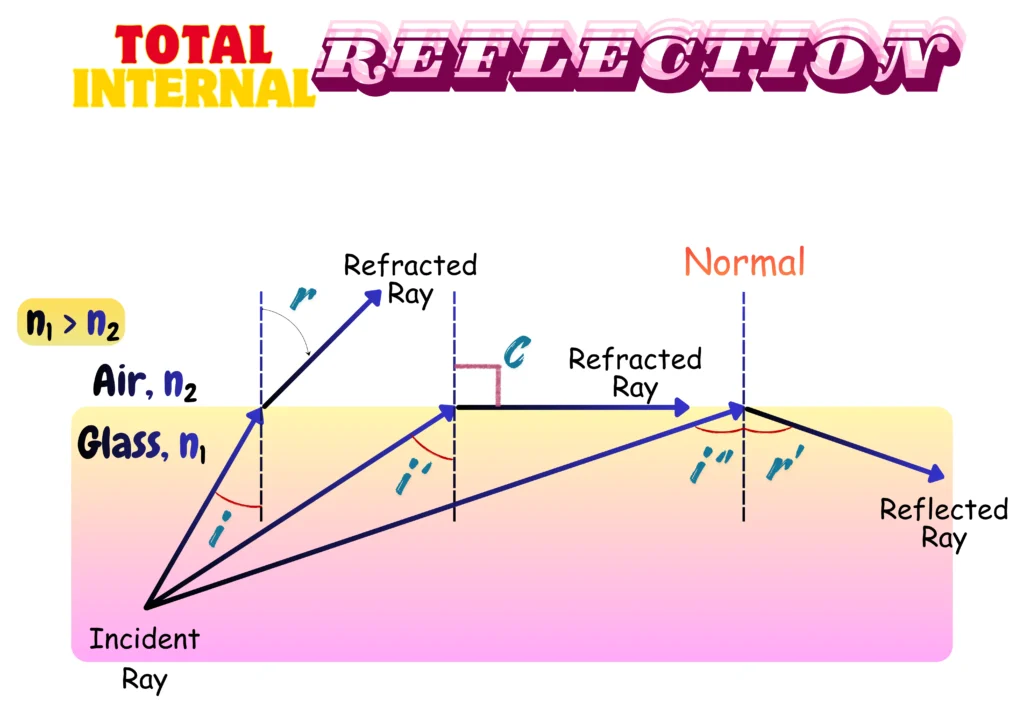
As the angle of incidence (the angle between the incident ray and the normal) increases i.e.,  :
:
- The refracted ray bends away from the normal.
- The angle of refraction becomes larger
 .
. - Eventually, the refracted ray reaches a maximum possible value (
 ), called the critical angle.
 .
.At this point, something special happens.
The Critical Angle
It is a specific angle of incidence at which the refracted ray travels exactly along the boundary between the two media.
It is represented by  and can be defined as:
“The angle of incidence in the denser medium for which the angle of refraction in the rarer medium becomes  ”.
”.
This means the refracted ray moves along the surface instead of entering the second medium.
Mathematical Relationship
Using Snell’s Law:

Where:




At the critical angle:

Substituting into Snell’s Law:

Since;

Hence;


If the rarer medium is air, then

Therefore;

Here,  is the refractive index of the denser medium.
Hence, the angle is:
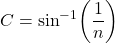
For glass, the critical angle is approximately  .
.
What is Total Internal Reflection?
TIR can be defined as:
“The phenomenon in which a light ray traveling from a denser medium to a rarer medium is completely reflected into the denser medium when the angle of incidence becomes greater than the critical angle, so that no refraction occurs in the rarer medium”.
OR
“The complete reflection of light back into a denser medium when it travels toward a rarer medium, and the angle of incidence exceeds the critical angle”.
Unlike ordinary reflection from mirrors, TIR has almost no loss of light intensity.
Conditions for Total Internal Reflection
Two conditions must be satisfied for TIR to occur:
1. Light must travel from a denser medium to a rarer medium
Examples include:
- Glass (denser) → Air (rarer)
- Water (denser) → Air (rarer)
If light travels from air to glass, total internal reflection cannot occur.
2. The angle of incidence must exceed the critical angle
If the angle is smaller than the critical angle, light will simply refract.
Mirage | A Natural Optical Illusion
Mirage is one of the fascinating phenomena related to TIR. They are commonly observed on hot roads or deserts, where the ground appears to be covered with water.
Temperature Layers in Air
On a hot day, air near the ground becomes very hot and less dense, while the air above remains cooler and denser.
This creates multiple layers of air with gradually changing refractive indices.
How does a Mirage Form?
Light from the sky travels downward through these layers.
As it passes through the changing air density:
- The light ray bends gradually.
- Eventually, it reaches an angle greater than the critical angle.
- Total internal reflection occurs.
The reflected ray reaches the observer’s eye.
Why the Road Looks Wet
Because the light originates from the sky but reaches the eye from the ground, the brain interprets it as a reflection from water.
This produces the illusion of a shiny water surface on the road.
Rainbows | Optical Masterpiece of Nature
One of the most beautiful natural displays of light is the rainbow. It is a multicoloured arc seen in the sky after rainfall.

To observe a rainbow:
- The Sun must be behind the observer
- Rain must be in front
A rainbow is essentially a natural solar spectrum.
How does a Rainbow Form?
- After rain, millions of tiny raindrops remain suspended in the air.
- Each raindrop acts like a tiny prism.
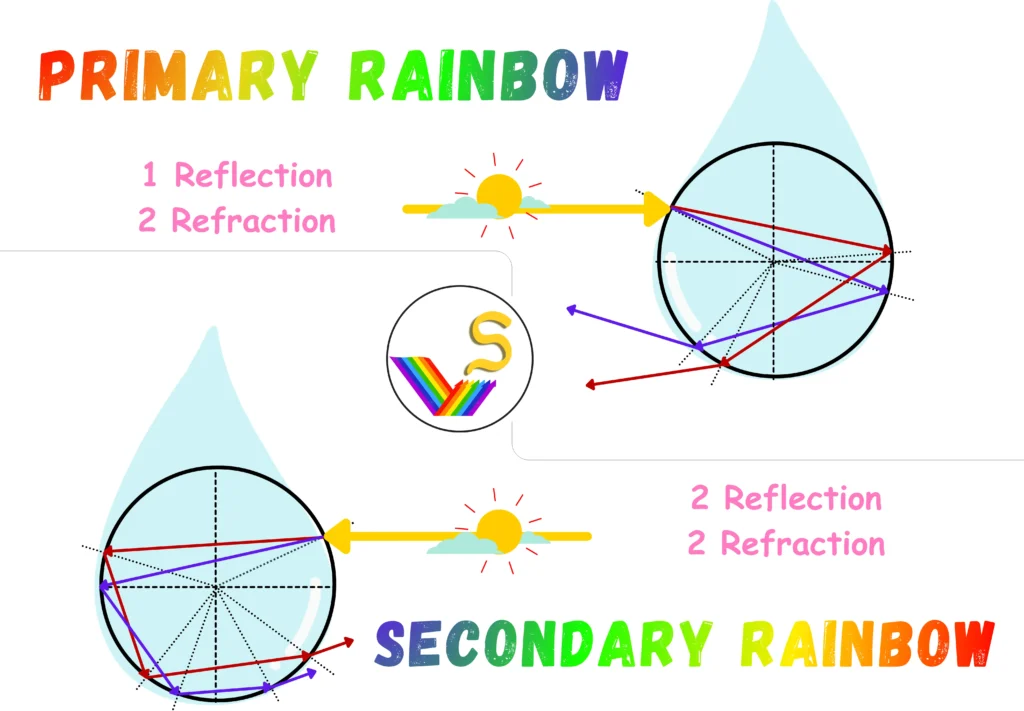
- Inside each drop, sunlight undergoes:
- Refraction when entering the drop
- Total internal reflection inside the drop
- Refraction again when leaving the drop
During this process, light is dispersed into different colours.
Difference between Primary Rainbow and Secondary Rainbow
| Feature | Primary Rainbow | Secondary Rainbow |
| Definition | The most common and brightest rainbow is seen after rainfall. | A second, fainter rainbow that sometimes appears outside the primary rainbow. |
| Optical Process | Light undergoes two refractions and one total internal reflection inside the raindrop. | Light undergoes two refractions and two total internal reflections inside the raindrop. |
| Brightness | Brighter and more clearly visible. | Fainter and less bright compared to the primary rainbow. |
| Position in the Sky | Appears closer to the centre of the rainbow arc. | Appears outside and above the primary rainbow. |
| Colour Arrangement | Red is on the outer edge and violet on the inner edge. | Violet is on the outer edge and red on the inner edge (reversed order). |
| Colour Order | Red → Orange → Yellow → Green → Blue → Indigo → Violet | Violet → Indigo → Blue → Green → Yellow → Orange → Red |
Conclusion
The study of light reveals an extraordinary world of optical phenomena, and TIR is one such fascinating optical phenomenon. It plays a key role in both nature and technology.
By understanding how light behaves between different media—bending, slowing down, or speeding up—we can explain why TIR occurs and why phenomena like mirages appear on hot roads or in deserts.
TIR is the foundation of many modern applications, including:
- Optical instruments
- Fibre-optic communication
- Medical imaging technologies
Frequently Asked Questions (FAQs)
What is total internal reflection (TIR)?
TIR is the complete reflection of light back into a denser medium when the angle of incidence exceeds the critical angle at the boundary with a rarer medium.
How does total internal reflection occur?
TIR occurs when light travels from a medium with a higher refractive index to one with a lower refractive index, and the angle of incidence is greater than the critical angle.
What is the critical angle in optics?
It is the specific angle of incidence in the denser medium at which the refracted light travels along the boundary (angle of refraction = 90°).
What is the difference between refraction and total internal reflection?
Refraction is the bending of light as it passes into another medium, while TIR is when light does not enter the second medium and is fully reflected.
Why does total internal reflection only occur from denser to rarer media?
Only when light goes from a higher refractive index to a lower one can the refracted ray reach an angle of 90°, enabling TIR.
What are real-life examples of total internal reflection?
Examples include mirages on hot roads, optical fibres, diamonds’ sparkle, and endoscopes in medical imaging.
How is the refractive index related to total internal reflection?
The refractive index determines how much light bends in a medium, and it is used to calculate the critical angle required for TIR to occur.
Can total internal reflection occur in water?
Yes. Light moving from water (denser) to air (rarer) can undergo TIR if the angle of incidence is greater than the water‑air critical angle.
What is a mirage, and how is it formed?
A mirage is an optical illusion caused by TIR in layers of air with different temperatures, making the ground appear reflective like water.
What are the applications of total internal reflection in technology?
TIR is used in fibre‑optic cables, binoculars, prisms, optical sensors, and medical imaging devices because it allows light to travel long distances with minimal loss.