
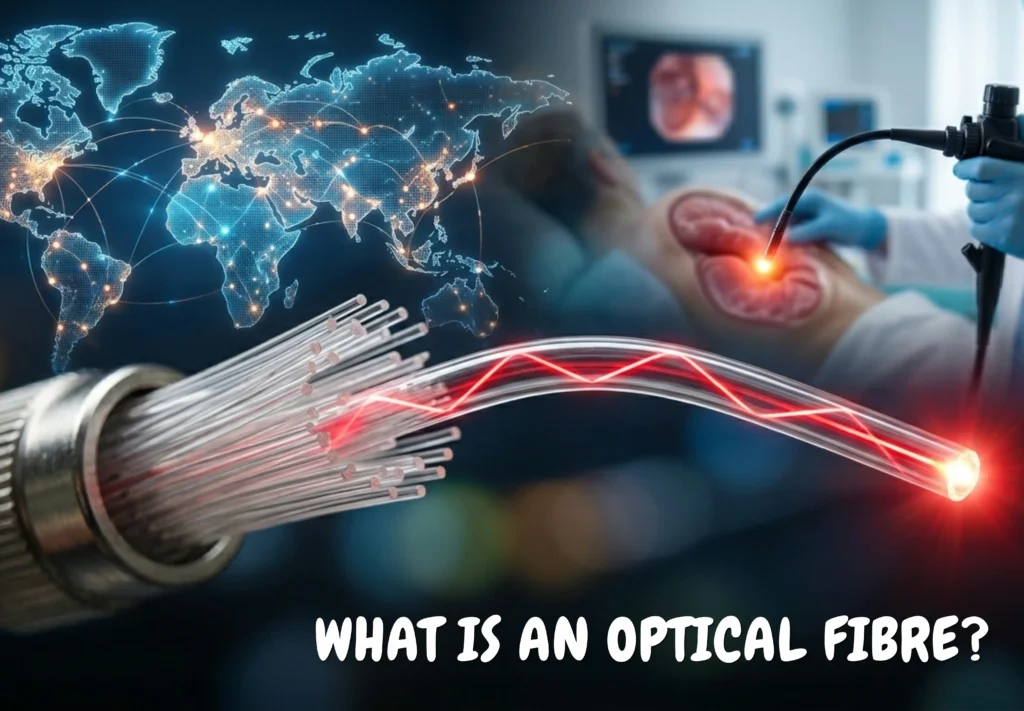
What is an optical fibre? A simple guide explaining its structure, working principle, and applications in modern communication and medical technology.
Table of Contents
Introduction
Optical fibres represent one of the most important technological applications of total internal reflection. These are extremely thin strands of glass or plastic that form the backbone of modern communication systems and many medical technologies.
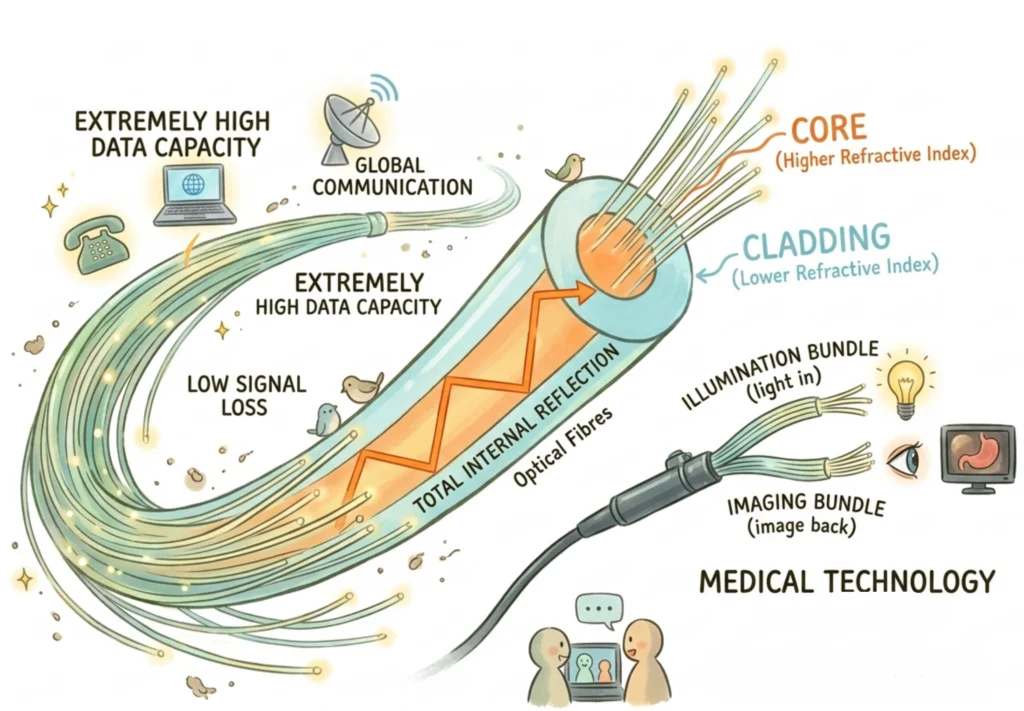
Optical fibres are capable of transmitting light signals over vast distances with minimal loss.
What is an Optical Fibre?
“An optical fibre is a very thin strand of glass or plastic designed to transmit light signals across long distances”.
An optical fibre carries enormous amounts of information using pulses of light. Since light travels extremely fast, optical fibres enable rapid and efficient data transmission. It is about the thickness of a human hair.
Structure of an Optical Fibre
An optical fibre consists of two main layers:
- Core
- Cladding
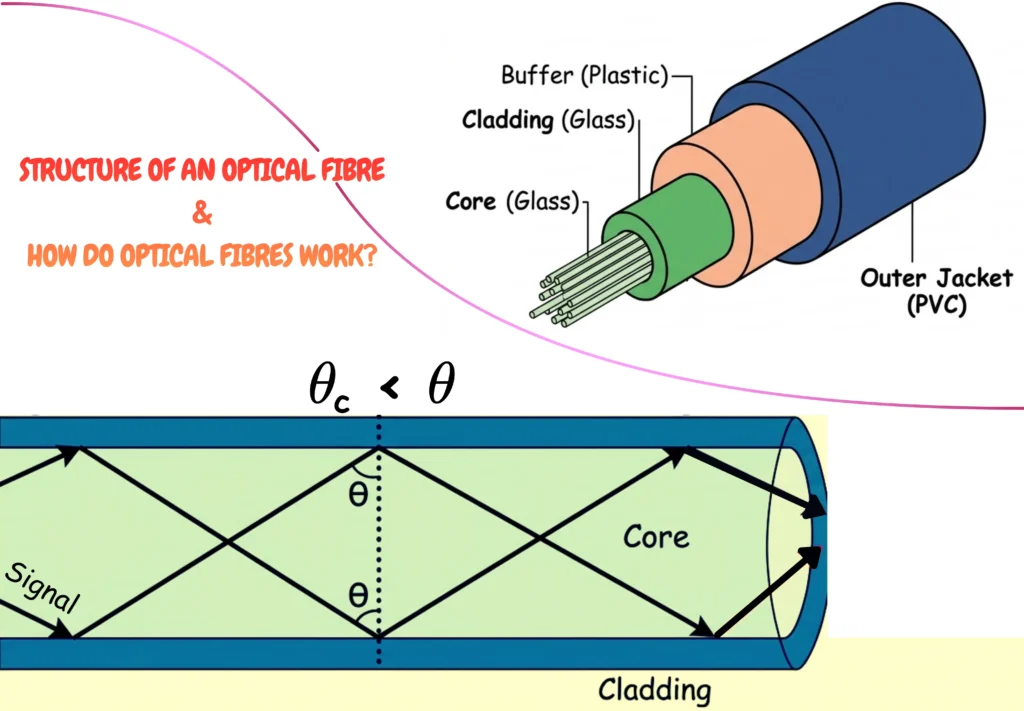
Each layer of the optical fibre has a different refractive index. This difference is essential for allowing light to remain confined within the fibre. The difference between these refractive indices ensures that light reflects internally rather than escaping from the fibre.
Differences between Core and Cladding
| Feature | Core | Cladding |
| Definition | The inner region of the optical fibre through which light travels. | The outer layer that surrounds the core and helps guide the light. |
| Position in Fibre | Located at the centre of the optical fibre. | Located around the core, forming the outer layer. |
| Main Function | Provides the pathway for light transmission along the fibre. | Ensures light remains inside the core by supporting total internal reflection. |
| Refractive Index | Higher refractive index than the cladding. | Lower refractive index than the core. |
| Approximate Value of Refractive Index | About 1.52 | About 1.48 |
| Role in Light Guidance | Carries the light signal through the fibre. | Reflects light into the core to prevent signal loss. |
How Optical Fibres Work?
Optical fibres operate based on the principle of total internal reflection. The following process occurs in an optical fibre:
- The light enters the core of the fibre
- The light ray strikes the boundary between the core and the cladding.
- If the angle of incidence is greater than the critical angle, total internal reflection occurs.
- The light ray reflects repeatedly along the length of the fibre.
The repeated reflection allows light signals to move efficiently through the fibre from one end to the other. As a result:
- The light remains trapped inside the fibre.
- It can travel very long distances without escaping.
- Even if the fibre bends slightly, the light continues reflecting internally.
Optical Fibre Communication
The development of optical fibres revolutionised modern telecommunications. Today, fibre-optic systems form the foundation of global communication networks.
Optical fibres are widely used in:
- Telephone Networks
- Internet Infrastructure
- Cable Television Systems
These networks rely on light pulses transmitted through fibres to carry enormous amounts of digital data.

Advantages of Optical Fibers
Optical fibers offer several important advantages over traditional copper cables.
1. Extremely High Data Capacity
Optical fibres can transmit large volumes of information using rapid light pulses. This allows high-speed internet and large-scale data transfer.
2. Low Signal Loss
Light signals travelling through fibre experience very little attenuation (meaning they can travel hundreds of kilometres with minimal loss).
3. Lightweight Cables
Fiber-optic cables are much lighter and thinner than copper cables, making installation easier and more efficient.
4. Immunity to Electromagnetic Interference
Unlike metal cables, optical fibres are not affected by electrical noise or electromagnetic interference, ensuring clearer signal transmission.
Because of these advantages, modern global communication networks rely heavily on fibre-optic technology.
Medical Applications of Optical Fibers
Optical fibers are not only important in communication systems but also play a vital role in modern medical technology. One important medical device that uses optical fibers is the endoscope.
What Is an Endoscope?
“An endoscope is a medical instrument used to observe the internal parts of the human body without performing major surgery”.
Doctors use endoscopes to examine organs, diagnose medical conditions, and sometimes perform minor surgical procedures.
How an Endoscope Works
An endoscope typically contains two bundles of optical fibers:
- Illuminated Bundle
- Imaging Bundle
Each bundle serves a different purpose. This arrangement allows doctors to clearly observe internal structures without making large surgical incisions.
Differences between Illumination Bundle and Imaging Bundle
| Feature | Illumination Bundle | Imaging Bundle |
| Primary Function | Sends light into the body. | Carries the reflected image back to the doctor. |
| Role in Examination | Illuminates the internal organ or body cavity being examined. | Transmits the image of the illuminated area for observation. |
| Type of Light Transmission | Transmits light from the external light source into the body. | Transmits reflected light from the organ to the viewing system. |
| Purpose in Endoscopy | Provides visibility inside the body by lighting the area. | Allows the doctor to see the internal structures clearly. |
| Output | Produces illumination inside the body. | Displays the image on a monitor using a small camera. |
Types of Endoscopes
Different endoscopes are designed to examine specific organs in the body. These instruments enable minimally invasive medical procedures, which significantly reduce patient recovery time and surgical risks. Some of the endoscopes are:
| Instrument | Function |
| Gastroscope | Used to examine the stomach |
| Bronchoscope | Used to examine the lungs and airways |
| Cystoscope | Used to examine the bladder |
Conclusion
Optical fibers are a remarkable application of total internal reflection. They use thin strands of glass or plastic to guide light efficiently over long distances.
Their unique structure, consisting of a core and cladding, allows light to remain trapped inside the fibre. This enables fast and reliable transmission of information.
Because of their high speed, low signal loss, and resistance to interference, optical fibers are essential in modern communication systems. They (optical fibers) power the internet, telephone networks, and cable television.
Optical fibers also play an important role in medical technology, especially in devices like endoscopes that allow doctors to examine the body without major surgery.
In short, optical fibers are a key technology of the modern world, connecting people, improving healthcare, and supporting global communication networks.
Frequently Asked Questions (FAQs)
What is an optical fibre?
An optical fiber is a very thin strand of glass or plastic that transmits light signals over long distances using total internal reflection.
How does an optical fibre work?
Light travels through the fibre’s core and repeatedly reflects at the boundary between the core and cladding. This process is called total internal reflection.
What are the main parts of an optical fiber?
An optical fiber has two main parts: the core, which carries light, and the cladding, which surrounds the core and keeps the light trapped inside.
Why does the core have a higher refractive index than the cladding?
The higher refractive index of the core allows total internal reflection to occur, which keeps the light confined within the fibre.
What is the refractive index of the core and cladding?
The refractive index of the core is approximately 1.52, while the cladding has a slightly lower refractive index of about 1.48.
What are the advantages of optical fibers?
Optical fibers offer high data capacity, low signal loss, lightweight cables, and immunity to electromagnetic interference.
Where are optical fibres used?
They are widely used in internet infrastructure, telephone networks, cable television systems, and medical devices.
What is optical fiber communication?
Optical fiber communication is the transmission of information as light pulses through optical fibers over long distances.
What is an endoscope and how does it use optical fibers?
An endoscope is a medical instrument used to view the inside of the body. It uses optical fibres to send light into the body and carry images back to a monitor.
What are the different types of endoscopes?
Common types include gastroscopes for the stomach, bronchoscopes for the lungs and airways, and cystoscopes for the bladder.